Day 5: Produce a Clear Written Message
What you will learn and leave with
This lesson teaches you how to produce a clear written message. It uses ChatGPT as a practical learning context while keeping privacy, accuracy, context, and human judgment in charge.
Use this when: you want to create a practical, reviewable work output with ChatGPT. By the end: you will save final team update draft and review-needs note.
Course position: Day 5 of 30 · ChatGPT module
Continue: Day 6: Use ChatGPT for Meeting Support
Source check: product features and interfaces can change. OpenAI ChatGPT Help Center was checked for this course on 2026-08-30; confirm current details before using a changing feature.
Listen to the Day 5 Introduction
This short audio introduces the day and what to focus on.
Day 5: Produce a Clear Written Message audio transcript
A message can sound polished and still leave the reader wondering, "Why am I getting this, and what am I supposed to do next?"
That is the problem today is designed to solve.
Welcome to Day 5 of the 30-Day AI at Work Challenge: Produce a Clear Written Message.
Today, you will move from writing support into a usable work output. The goal is a clear message that another person could realistically review, revise, or act on.
Let's start with the message spine. A strong workplace message usually answers four questions. Who is this for? Why are they receiving it? What do they need to understand? What should happen next?
If one of those pieces is missing, the reader has to fill in the gap. That can create confusion, especially when the message touches customers, product changes, AI, timing, approvals, or review needs.
AI can help you draft the message. But you still need to protect the spine. Do not let the tool add unsupported benefits, vague urgency, or confident language that the situation does not support.
Today's lesson gives you a mock workplace scenario and asks you to create a short team update. You will define the audience, draft the message, compare versions, and mark what would need review before real use.
There is also a worked example in the lesson. Use it as a model for what "clear enough to review" sounds like.
Before you begin, think about one message you have seen recently that looked fine but did not make the next step obvious. What was missing?
By the end, you will save a final team update draft and a review-needs note. The win is not fancy wording. The win is a message with a clear reason to exist.
Why It Matters
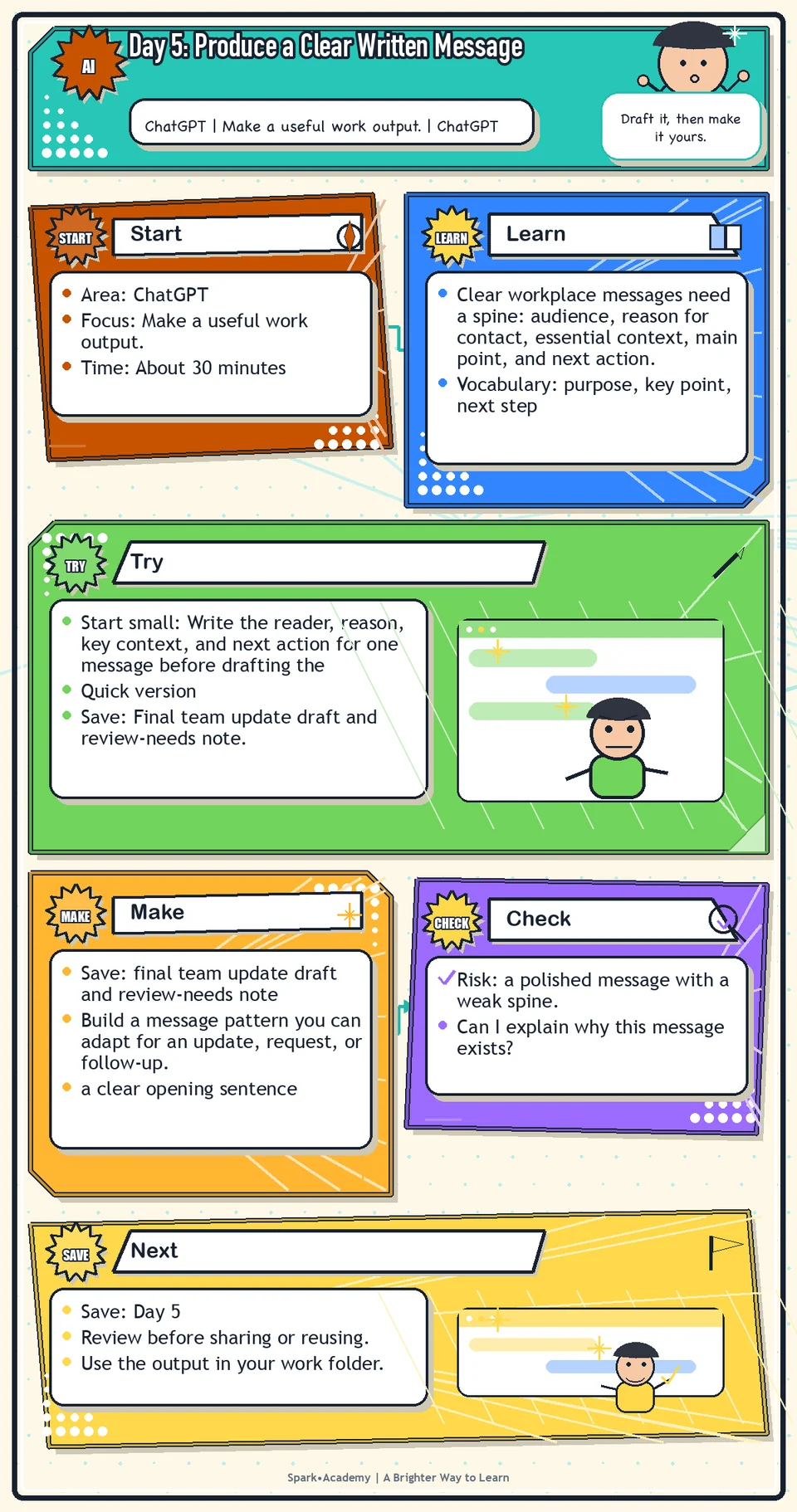
Clear workplace messages need a spine: audience, reason for contact, essential context, main point, and next action. Without that spine, polished sentences can still leave readers unsure what matters.
Updates, requests, announcements, and follow-ups often need to become reviewable before everything feels perfectly settled. A useful draft makes review easier by showing what is known, what is being asked, and what still needs confirmation.
Save a message that another person could realistically review. It should remove unsupported benefits, unnecessary confidence, vague urgency, and any detail that makes the message sound more certain than the situation allows.
Know Before You Try
A clear workplace message needs a message spine: reader, reason, reality, and response.
The reader is who the message is for. The reason is why they are receiving it. The reality is what is happening, what matters, and who is affected. The response is the action, decision, review, or follow-up needed.
The spine keeps the message from becoming either too polished or too vague. If the reader is missing, people do not know whether to act. If the reason is missing, the message feels random. If the reality is missing, the message lacks substance. If the response is missing, the reader has to guess what happens next.
This matters most when the topic involves customers, product changes, decisions, approvals, or AI-assisted work. In those cases, readers often fill gaps with assumptions.
Use AI to draft and check the spine, then simplify. The best message is often shorter, more direct, and more specific than the first AI version.
Before you try
- A clear message usually has five parts: audience, purpose, key point, useful context, and the action or decision needed next.
- For workplace writing, clarity beats cleverness. The reader should know what happened, why it matters, and what they are supposed to do.
- If the topic touches product performance, customer impact, legal risk, financial claims, or public positioning, mark review needs inside the draft instead of hiding them.
Where this helps
Use this workflow when drafting team updates, decision notes, project announcements, workflow update notes, or follow-ups after decisions.
- drafting a team update, follow-up, announcement, or request
- you need to make a message shorter and easier to act on
- you want to compare several versions before choosing a final direction
Try It
Start small: Write the reader, reason, key context, and next action for one message before drafting the sentences.
Quick version
- Save: Final team update draft and review-needs note.
- Minimum useful version: Write one message under 150 words with audience, reason, key context, and next action.
- If stuck: "Reader: reviewing team. Reason: prepare for a customer experience update. Next action: review the draft for accuracy and risk."
- Done when: You can point to the reader, reason, reality, response, and review need in the draft.
- Add only if useful: Create a second version for a different audience and compare what changed.
Aim for
- Reader: Reviewing team.
- Reason: Prepare for a customer experience update.
- Message draft: "We are preparing a customer experience update for review. The point is to make support information easier to find and understand. Please review the draft for accuracy, customer impact, and any claims that need approval before we share next steps."
- Why this works: It names the audience, context, action, and review need without overpromising.
Practice
Use this scenario: "A mock workplace is preparing to roll out an improvement to the customer experience. The update is intended to make support easier to access and easier to understand." Then work through the message in stages:
- Ask ChatGPT to draft a short team update under 150 words.
- Ask for a sharper version for the reviewing team.
- Compare the two versions and notice what changed: audience, tone, level of detail, and level of confidence.
- Create one final version that keeps the clearest parts of both drafts.
- Add a note under the final version listing what would need relevant subject-matter, legal, privacy, or compliance review before real use.
Work in passes:
- Define the audience in one sentence.
- Write the main point before asking AI to help.
- Ask for a draft, then ask for a shorter version.
- Review the final message against the audience, purpose, and next step.
If you do not know what topic to use, choose a harmless mock update: a project timeline change, a meeting follow-up, a request for feedback, or a team reminder.
Before you save it:
- Make one pass for structure and one pass for risk. Do not try to solve both at the same time.
- Read the final message aloud or scan the first sentence of each paragraph to make sure the logic flows.
Prompt
Primary Prompt
Use this to get a first useful draft.
Draft a short team update under 150 words for this safe or mock scenario: a workplace is preparing to roll out an improvement to the customer experience. The update is intended to make support easier to access and easier to understand. Then create a sharper concise version and help me compare the two.Role:
Act as a concise workplace communicator.
Task:
Draft a short team update under 150 words for this safe or mock scenario: a workplace is preparing to roll out an improvement to the customer experience. The update is intended to make support easier to access and easier to understand. Then create a sharper concise version and help me compare the two.
Context:
- Keep in mind: A clear workplace message should explain what is happening, why it matters, who is affected, and what happens next without adding unsupported claims.
- Work context: clear workplace message drafting.
- Save as: short team update.
Use these details if I provide them:
- Scenario.
- Audience.
- Length limit.
- Must-include facts and things not to promise.
Ask first only if needed:
- Ask up to three clarifying questions only when missing details would materially change the answer. Otherwise, proceed with clearly labeled assumptions or placeholders.
Keep it safe:
- Use only mock, public, sanitized, or workplace-approved information. Do not include sensitive, confidential, personal, customer, legal, financial, unreleased, private-code, credential, or regulated material unless that use is explicitly approved.
- Do not invent names, dates, metrics, source content, evidence, approvals, or promises. If details are missing, use labeled placeholders or a brief mock example.
How to work:
- Draft a short update within the requested word limit.
- Make the change, reason, and next step obvious.
- Create a sharper version and explain the difference.
Give me:
1. Safe assumptions for the mock scenario
2. Team update under 150 words
3. What changed, why it matters, and who is affected
4. Review flags before sending
5. Optional tighter version
6. Reusable team-update prompt pattern
Style:
- Practical, clear, friendly, plain-English, specific, and non-hype.
- Use headings, bullets, or a compact table when that makes the output easier to scan.
Before you finish:
- The update should be short, specific, useful, and ready for human review.
- Make sure the answer is usable, grounded in provided or clearly labeled mock information, and clear about what needs human review before real use.Improve Prompt
Use this to make the message clearer and safer.
Review the team update for audience fit, clarity, missing context, unsupported claims, vague wording, and next-step usefulness. Then suggest a tighter version under 120 words that keeps the meaning grounded.Role:
Act as a workplace message reviewer who checks audience fit, missing context, and next-step clarity.
Task:
Review the team update for audience fit, clarity, missing context, unsupported claims, vague wording, and next-step usefulness. Then suggest a tighter version under 120 words that keeps the meaning grounded.
Context:
- Keep in mind: A clear workplace message should explain what is happening, why it matters, who is affected, and what happens next without adding unsupported claims.
- Work context: clear workplace message drafting.
- Save as: short team update.
Use these details if I provide them:
- Scenario.
- Audience.
- Length limit.
- Must-include facts and things not to promise.
Ask first only if needed:
- Ask up to three clarifying questions only when missing details would materially change the answer. Otherwise, proceed with clearly labeled assumptions or placeholders.
Keep it safe:
- Use only mock, public, sanitized, or workplace-approved information. Do not include sensitive, confidential, personal, customer, legal, financial, unreleased, private-code, credential, or regulated material unless that use is explicitly approved.
- Do not invent names, dates, metrics, source content, evidence, approvals, or promises. If details are missing, use labeled placeholders or a brief mock example.
How to work:
- Review the message for audience fit, missing context, vague wording, and unsupported claims.
- Suggest a tighter version that stays grounded.
- Identify what should be verified before sending.
Give me:
1. Quick verdict
2. Issue table with priority, evidence, and recommended fix
3. Revised draft or targeted rewrite
4. Questions or approvals still needed
5. Before-use review checklist
6. Reusable review prompt pattern
Style:
- Practical, clear, friendly, plain-English, specific, and non-hype.
- Use headings, bullets, or a compact table when that makes the output easier to scan.
Before you finish:
- The update should be short, specific, useful, and ready for human review.
- Make sure the answer is usable, grounded in provided or clearly labeled mock information, and clear about what needs human review before real use.Apply Prompt
Use this to build your own message pattern.
Help me create a reusable team-update template for a safe, approved, or mock workplace change. Include purpose, what is changing, why it matters, who is affected, what happens next, and review notes before sending.Role:
Act as a practical communication coach who helps me turn a safe workplace change into a clear team-update template.
Task:
Help me create a reusable team-update template for a safe, approved, or mock workplace change. Include purpose, what is changing, why it matters, who is affected, what happens next, and review notes before sending.
Context:
- Keep in mind: A clear workplace message should explain what is happening, why it matters, who is affected, and what happens next without adding unsupported claims.
- Work context: clear workplace message drafting.
- Save as: short team update.
Use these details if I provide them:
- Scenario.
- Audience.
- Length limit.
- Must-include facts and things not to promise.
Ask first only if needed:
- Ask up to three clarifying questions only when missing details would materially change the answer. Otherwise, proceed with clearly labeled assumptions or placeholders.
Keep it safe:
- Use only mock, public, sanitized, or workplace-approved information. Do not include sensitive, confidential, personal, customer, legal, financial, unreleased, private-code, credential, or regulated material unless that use is explicitly approved.
- Do not invent names, dates, metrics, source content, evidence, approvals, or promises. If details are missing, use labeled placeholders or a brief mock example.
How to work:
- Build a reusable team-update template.
- Include purpose, change, reason, impact, next step, and review notes.
- Show how to adapt the template to a safe example.
Give me:
1. Questions to ask me first
2. Safe assumptions if I do not answer yet
3. Reusable team-update template
4. Filled mock example
5. Review notes before sending
6. Optional shorter version
7. Reusable team-update prompt pattern
Style:
- Practical, clear, friendly, plain-English, specific, and non-hype.
- Use headings, bullets, or a compact table when that makes the output easier to scan.
Before you finish:
- The update should be short, specific, useful, and ready for human review.
- Make sure the answer is usable, grounded in provided or clearly labeled mock information, and clear about what needs human review before real use.Make Something Useful
Build a message pattern you can adapt for an update, request, or follow-up.
Save final team update draft and review-needs note.
Make sure it includes:
- a clear opening sentence
- only the context the reader needs
- one obvious next step or takeaway
- language that avoids unsupported claims or unnecessary drama
Worked example: clear message
Scenario: A project timeline changed after a dependency moved by one week.
Draft to aim for:
Hi team, the enablement draft will move from Thursday to next Tuesday because the product screenshots are still being finalized. This affects the review timeline, not the launch date. Please send any must-include feedback by Friday at noon so I can incorporate it before the updated draft goes out. I will flag anything that still needs product or legal review in the document.
Why this works: The reader knows what changed, why it changed, who is affected, what is not changing, and what action is needed next.
Review and Save
Specific risk to check: The risk today is a polished message with a weak spine: unclear audience, missing reason, unsupported claims, or no obvious next action.
Ask whether the message is clear, whether the audience is obvious, whether anything is overstated, whether customer impact is described carefully, and whether the message needs review.
Ask yourself:
- Can I explain why this message exists?
- Would the reader know what to do next?
- Did AI add any assumptions, promises, or facts?
- Does this need review before being sent in a real workplace?
Watch for
AI can help draft a message, but it cannot know what is approved, sensitive, or ready to share unless you provide that context.
Do not let AI turn a simple message into a press release. Many workplace messages are better when they are plain, specific, and easy to act on.
Save
Save this in your 30-day work folder as Day 5 - final team update draft and review-needs note.
Add a quick reuse note: Use this at work for: drafting a team update, stakeholder note, follow-up, or review request with a clear next step.
Save this as a reusable example. Later, you can adapt the structure for updates, follow-ups, and requests without starting from scratch.
Check yourself
- I created a clear team update draft.
- I created a version for a different audience.
- I compared how the message changed for different audiences.
- I created one final draft.
- I checked the message for clarity, tone, and overstatement.
- I know what would need review before the message could be used at work.
- I can point to the audience, purpose, and next step in my final message.
- I can use the message spine to draft a work update or request that has a clear audience, purpose, and next step.