Day 23: Use Gemini for Search Intent, SEO, and AEO
What you will learn and leave with
Day 23 teaches you how to use Gemini to map reader intent, plan useful SEO and AEO content, draft FAQ ideas, and identify claims that need evidence or human review. It is an educational planning exercise within the 30-Day AI at Work Challenge.
Use this when: you are planning public-facing content and need to understand what readers are trying to learn, compare, or do. By the end: you will save search intent, SEO, AEO, and FAQ notes.
Course position: Day 23 of 30 · Gemini module
Continue: Day 24: Produce a Web Friendly Content Outline
Source check: product features and interfaces can change. Gemini for Google Workspace Help was checked for this course on 2026-08-30; confirm current details before using a changing feature.
Listen to the Day 23 Introduction
This short audio introduces the day and what to focus on.
Day 23: Use Gemini for Search Intent, SEO, and AEO audio transcript
Before you think about keywords, think about the person searching.
What are they trying to understand? What would help them trust the answer? What would make them leave still confused?
Welcome to Day 23 of the 30-Day AI at Work Challenge: Use Gemini for Search Intent, SEO, and AEO.
Today is about public-facing clarity. SEO helps content be discoverable in search. AEO, or answer engine optimization, is about helping answer systems understand and surface useful answers. But both should start with real reader intent.
Here is the main idea. Search intent is the reason behind a question. A reader may want to learn, compare, decide, troubleshoot, or build trust. If your content does not match that intent, keywords will not save it.
Gemini can help you explore audience questions, topic ideas, headings, FAQs, and answer-focused structure. But the goal is not to chase visibility at the expense of usefulness.
The risk today is optimizing past the truth. Public content should not force keywords, invent benefits, or make unsupported claims just to sound stronger.
In the lesson, you will use a topic like AI-supported customer support and think through how different audiences might search for it. You will group questions by intent and mark claims that need evidence or review.
Before you start, ask yourself: What are the top three questions a reader would need answered before trusting or acting on this content?
By the end, you will save search intent, SEO, AEO, and FAQ notes. The win is reader-first structure that is also easier for search and answer systems to understand.
Why It Matters
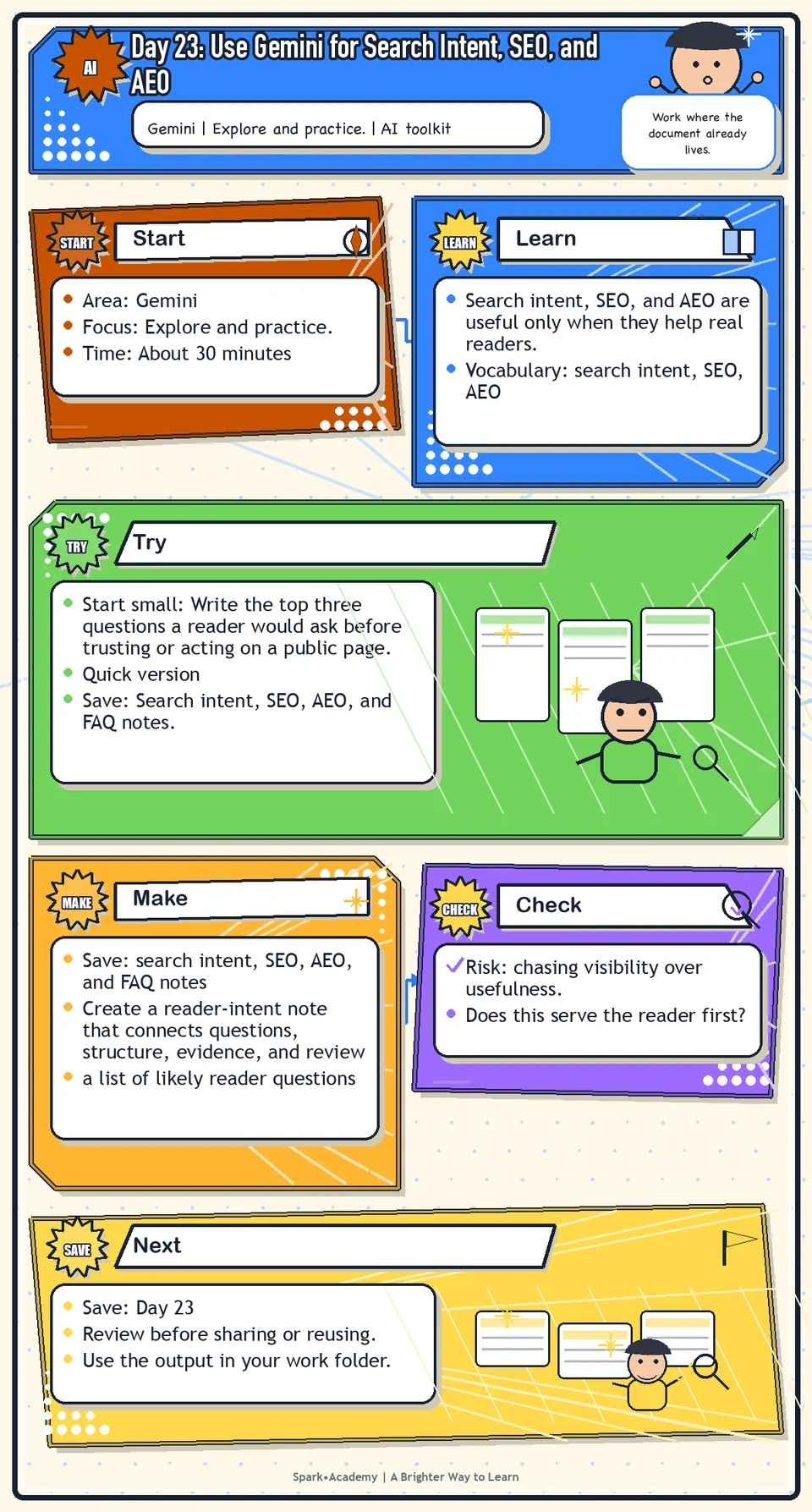
Search intent, SEO, and AEO are useful only when they help real readers. Start with what the audience is trying to understand, what answer would satisfy them, and what proof or caution the content needs.
Public-facing content fails when it chases keywords instead of intent or makes claims broader than the evidence allows. Visibility work should make content clearer, not louder.
Save a reader-intent note that connects questions, direct answers, evidence needs, FAQ opportunities, and trust signals. It should avoid keyword stuffing, promotional overreach, and unsupported authority.
Know Before You Try
Public content should answer real audience questions. Search intent is the reason behind a query: what the reader wants to know, do, compare, choose, or solve.
SEO helps content be discoverable and understandable to search engines and readers. AEO, or answer engine optimization, focuses on making answers clear enough for answer-style and AI-assisted experiences.
The practical habit is reader-first answer design: identify likely questions, answer them directly, organize the page with useful headings, and include FAQ-style follow-ups when they help.
Search-friendly content is not keyword stuffing. Do not add keywords, claims, or answers that the content cannot support. A clear, accurate answer is more valuable than a page that sounds optimized but does not help the reader.
This lesson teaches an educational planning method. You are practicing how to understand readers, organize useful answers, and review public-facing content. You are not creating an AEO service pitch or replacing subject-matter, editorial, legal, privacy, or accessibility review.
Write for humans first, then structure the content so humans and systems can understand it. Public content should be reviewed for accuracy, sensitivity, source support, and approval needs before publication.
Before you try
- Search intent means understanding what the reader is trying to accomplish, not just which keywords they might type.
- Google's guidance for generative AI features still points back to strong SEO fundamentals: useful people-first content, crawlable pages, clear structure, and content that can be trusted.
- AEO and GEO are terms people use, but for Google Search the practical advice is still to make helpful, accessible, well-structured content for real users.
Where this helps
Use this for blog posts, public FAQs, web pages, media resources, explainers, and content that may appear in search results.
- planning public-facing web content
- writing FAQs, explainers, blog outlines, or help content
- reviewing whether a page answers the questions readers actually have
Try It
Start small: Write the top three questions a reader would ask before trusting or acting on a public page.
Quick version
- Save: Search intent, SEO, AEO, and FAQ notes.
- Minimum useful version: Pick one public-facing topic, list five reader questions, group them by intent, and draft three FAQ answers.
- If stuck: Start with the reader question before any keyword: "What is the person trying to understand?"
- Done when: The notes serve the reader first and mark claims that need evidence or review.
- Add only if useful: Add one section showing what a search engine might need and what a human reader needs.
Aim for
- Reader question: "How does AI-supported customer support work?"
- Intent: Understand, not buy.
- Direct answer: "AI-supported support can help organize information, but the exact experience depends on the workflow and human review."
- Review flag: "Confirm product details and avoid unsupported customer outcome claims."
Practice
Use the topic: "AI-supported customer support." Ask Gemini how different audiences might search for the topic. Group searches by:
- Customer.
- Journalist.
- Employer.
- Business reader.
Then ask for SEO and AEO improvements, including:
- Keywords.
- Questions to answer.
- Section headings.
- A short FAQ.
- Claims that would need subject-matter, legal, privacy, compliance, or other appropriate review.
Work in passes:
- Choose a topic a reader might search for.
- List the questions they might ask before, during, and after reading.
- Group the questions by intent: learn, compare, decide, troubleshoot, or trust-building.
- Ask Gemini or ChatGPT to suggest a helpful content structure, then revise it yourself.
If you only think of keywords, switch to questions. Ask: "What would someone type if they were confused, cautious, curious, or ready to act?"
Before you save it:
- Write three reader intents for the same topic: learn, compare, and decide.
- For each intent, draft one question the page should answer and one proof point the answer would need.
If you find a question-and-answer pattern you would reuse, save it in The AI Prompt Library and keep the Prompt Library PDF as a copy-friendly reference.
Prompt
Primary Prompt
Use this to get a first useful draft.
For the topic AI-supported customer support, identify how customers, journalists, employers, and business readers might search for it. Suggest keywords, questions to answer, section headings, a short FAQ, and claims that need subject-matter, legal, privacy, compliance, or other appropriate review.Role:
Act as a reader-intent strategist.
Task:
For the topic AI-supported customer support, identify how customers, journalists, employers, and business readers might search for it. Suggest keywords, questions to answer, section headings, a short FAQ, and claims that need subject-matter, legal, privacy, compliance, or other appropriate review.
Context:
- Keep in mind: Search intent, SEO, and AEO work best when content answers real reader questions directly while marking claims that need review.
- Work context: search intent, SEO, AEO, and reader questions.
- Save as: search intent and FAQ notes.
Use these details if I provide them:
- Safe public-facing topic.
- Audiences.
- Claims needing review.
Ask first only if needed:
- Ask up to three clarifying questions only when missing details would materially change the answer. Otherwise, proceed with clearly labeled assumptions or placeholders.
Keep it safe:
- Use only mock, public, sanitized, or workplace-approved information. Do not include sensitive, confidential, personal, customer, legal, financial, unreleased, private-code, credential, or regulated material unless that use is explicitly approved.
- Do not invent names, dates, metrics, source content, evidence, approvals, or promises. If details are missing, use labeled placeholders or a brief mock example.
How to work:
- Identify how different audiences might search or ask questions.
- Suggest keywords, headings, FAQ, and review-sensitive claims.
- Separate search intent from answer-engine questions.
Give me:
1. Audience search-intent map
2. Keywords and reader questions
3. Suggested section headings
4. FAQ and answer-engine opportunities
5. Claims that need review
6. Reusable search-intent prompt pattern
Style:
- Practical, clear, friendly, plain-English, specific, and non-hype.
- Use headings, bullets, or a compact table when that makes the output easier to scan.
Before you finish:
- The output should make content more useful for readers, not just more optimized.
- Make sure the answer is usable, grounded in provided or clearly labeled mock information, and clear about what needs human review before real use.Improve Prompt
Use this to make the content more useful for readers.
Review these search intent, SEO, and AEO ideas. Separate customer questions, journalist questions, employer questions, and business-reader questions. Flag headings or FAQ answers that sound generic, unsupported, or too promotional.Role:
Act as a search-intent reviewer who checks reader questions, FAQ quality, unsupported claims, and audience fit.
Task:
Review these search intent, SEO, and AEO ideas. Separate customer questions, journalist questions, employer questions, and business-reader questions. Flag headings or FAQ answers that sound generic, unsupported, or too promotional.
Context:
- Keep in mind: Search intent, SEO, and AEO work best when content answers real reader questions directly while marking claims that need review.
- Work context: search intent, SEO, AEO, and reader questions.
- Save as: search intent and FAQ notes.
Use these details if I provide them:
- Safe public-facing topic.
- Audiences.
- Claims needing review.
Ask first only if needed:
- Ask up to three clarifying questions only when missing details would materially change the answer. Otherwise, proceed with clearly labeled assumptions or placeholders.
Keep it safe:
- Use only mock, public, sanitized, or workplace-approved information. Do not include sensitive, confidential, personal, customer, legal, financial, unreleased, private-code, credential, or regulated material unless that use is explicitly approved.
- Do not invent names, dates, metrics, source content, evidence, approvals, or promises. If details are missing, use labeled placeholders or a brief mock example.
How to work:
- Review ideas for usefulness and specificity.
- Separate audience question types.
- Flag generic, unsupported, or promotional ideas.
Give me:
1. Quick verdict
2. Issue table with priority, evidence, and recommended fix
3. Revised draft or targeted rewrite
4. Questions or approvals still needed
5. Before-use review checklist
6. Reusable review prompt pattern
Style:
- Practical, clear, friendly, plain-English, specific, and non-hype.
- Use headings, bullets, or a compact table when that makes the output easier to scan.
Before you finish:
- The output should make content more useful for readers, not just more optimized.
- Make sure the answer is usable, grounded in provided or clearly labeled mock information, and clear about what needs human review before real use.Apply Prompt
Use this to analyze a safe public-facing topic.
Ask me for a safe, approved, or mock public-facing topic and audience. Then identify search intent, keywords, reader questions, section headings, FAQ opportunities, answer-engine questions, and claims needing review.Role:
Act as a practical search-intent coach who helps me adapt reader-question analysis to a safe public-facing topic.
Task:
Ask me for a safe, approved, or mock public-facing topic and audience. Then identify search intent, keywords, reader questions, section headings, FAQ opportunities, answer-engine questions, and claims needing review.
Context:
- Keep in mind: Search intent, SEO, and AEO work best when content answers real reader questions directly while marking claims that need review.
- Work context: search intent, SEO, AEO, and reader questions.
- Save as: search intent and FAQ notes.
Use these details if I provide them:
- Safe public-facing topic.
- Audiences.
- Claims needing review.
Ask first only if needed:
- Ask up to three clarifying questions only when missing details would materially change the answer. Otherwise, proceed with clearly labeled assumptions or placeholders.
Keep it safe:
- Use only mock, public, sanitized, or workplace-approved information. Do not include sensitive, confidential, personal, customer, legal, financial, unreleased, private-code, credential, or regulated material unless that use is explicitly approved.
- Do not invent names, dates, metrics, source content, evidence, approvals, or promises. If details are missing, use labeled placeholders or a brief mock example.
How to work:
- Ask for safe topic and audience.
- Identify search intent, keywords, reader questions, headings, FAQ, AEO questions, and review claims.
Give me:
1. Questions to ask me first
2. Safe assumptions if I do not answer yet
3. Adapted search intent and FAQ notes
4. Review before real use
5. Reusable prompt pattern
Style:
- Practical, clear, friendly, plain-English, specific, and non-hype.
- Use headings, bullets, or a compact table when that makes the output easier to scan.
Before you finish:
- The output should make content more useful for readers, not just more optimized.
- Make sure the answer is usable, grounded in provided or clearly labeled mock information, and clear about what needs human review before real use.Make Something Useful
Create a reader-intent note that connects questions, structure, evidence, and review needs.
Save search intent, SEO, AEO, and FAQ notes.
Make sure it includes:
- a list of likely reader questions
- intent categories
- content sections that answer those questions
- notes about trust, evidence, and review needs
Review and Save
Specific risk to check: The risk today is chasing visibility over usefulness. Keywords, SEO, AEO, and search ideas should not create unsupported claims or content that serves algorithms more than readers.
Make sure the content stays helpful and accurate. Do not force keywords. Do not make claims just to rank.
Ask yourself:
- Does this serve the reader first?
- Are we answering real questions or just chasing search terms?
- What evidence, expertise, or review would make the content trustworthy?
- Could any answer be misleading if summarized by an AI system?
Watch for
SEO and AEO should support clarity, not distort it. Workplace content about AI should prioritize trust, accuracy, and usefulness over traffic.
Do not treat SEO or AEO as a shortcut around quality. Search systems and readers both reward usefulness over empty optimization.
Save
Save this in your 30-day work folder as Day 23 - search intent, SEO, AEO, and FAQ notes.
Add a quick reuse note: Use this at work for: planning public-facing content around reader questions, search intent, FAQ needs, and trust signals.
Save the note in your work folder and prompt library. Reader-question lists are reusable for briefs, FAQs, outlines, and stakeholder conversations.
Check yourself
- I used Gemini to explore search intent.
- I grouped search questions by audience.
- I generated keyword or topic ideas.
- I created FAQ or answer focused ideas.
- I checked whether the content stayed helpful and accurate.
- I understand that SEO and AEO should support clarity, not distort it.
- I can distinguish a keyword from the reader intent behind it.
- I can connect reader questions, search intent, SEO, AEO, evidence, and trust in a content plan.
Optional video
Watch: Google Search Gen AI Reports, Search Profiles & more (Q2 '26) (official Google Search Central YouTube channel, 6:29).
Why it helps: It is a current official Search Central update that helps participants connect search visibility with generative AI features.