Day 30: Capstone Part 3, Polish, Review, and Build Your Personal AI Playbook
What you will learn and leave with
This lesson teaches you how to polish, review, and build your personal AI playbook. It uses Capstone Project as a practical learning context while keeping privacy, accuracy, context, and human judgment in charge.
Use this when: you want to combine course skills into a finished, reviewable learning artifact. By the end: you will save final capstone revisions and My AI Playbook.
Course position: Day 30 of 30 · Capstone Project module
Continue: What Success Looks Like
Source check: product features and interfaces can change. NIST AI Risk Management Framework was checked for this course on 2026-08-30; confirm current details before using a changing feature.
Listen to the Day 30 Introduction
This short audio introduces the day and what to focus on.
Day 30: Capstone Part 3, Polish, Review, and Build Your Personal AI Playbook audio transcript
The final step is not just making the package sound better.
It is deciding what you can stand behind, what needs review, and what you want to repeat in future work.
Welcome to Day 30 of the 30-Day AI at Work Challenge: Capstone Part 3, Polish, Review, and Build Your Personal AI Playbook.
Today, you will finish the capstone and turn the last month of practice into a personal way of working.
Let's start with the main idea. The final skill is judgment. Tool choice matters. Prompting matters. Drafting matters. But the lasting value is knowing how to use AI without losing accuracy, privacy, source support, tone, or human responsibility.
That is what your personal AI playbook should capture.
It should answer practical questions. When should you use each tool? What prompts are worth saving? What information should never go into an AI tool without approval? What review checks do you need before sharing? What workflows actually helped you?
The risk today is declaring the work finished too soon. A polished package may still need accuracy checks, review flags, privacy boundaries, and expert confirmation.
In the lesson, you will review your capstone package, pressure test it, revise it, mark what still needs human review, and save your playbook.
Before you begin, think back to Day 1. What has changed in how you think about AI at work?
By the end, you will save final capstone revisions and "My AI Playbook." That is the real finish line: not just one completed package, but a repeatable way to use AI with skill, care, and judgment.
Why It Matters
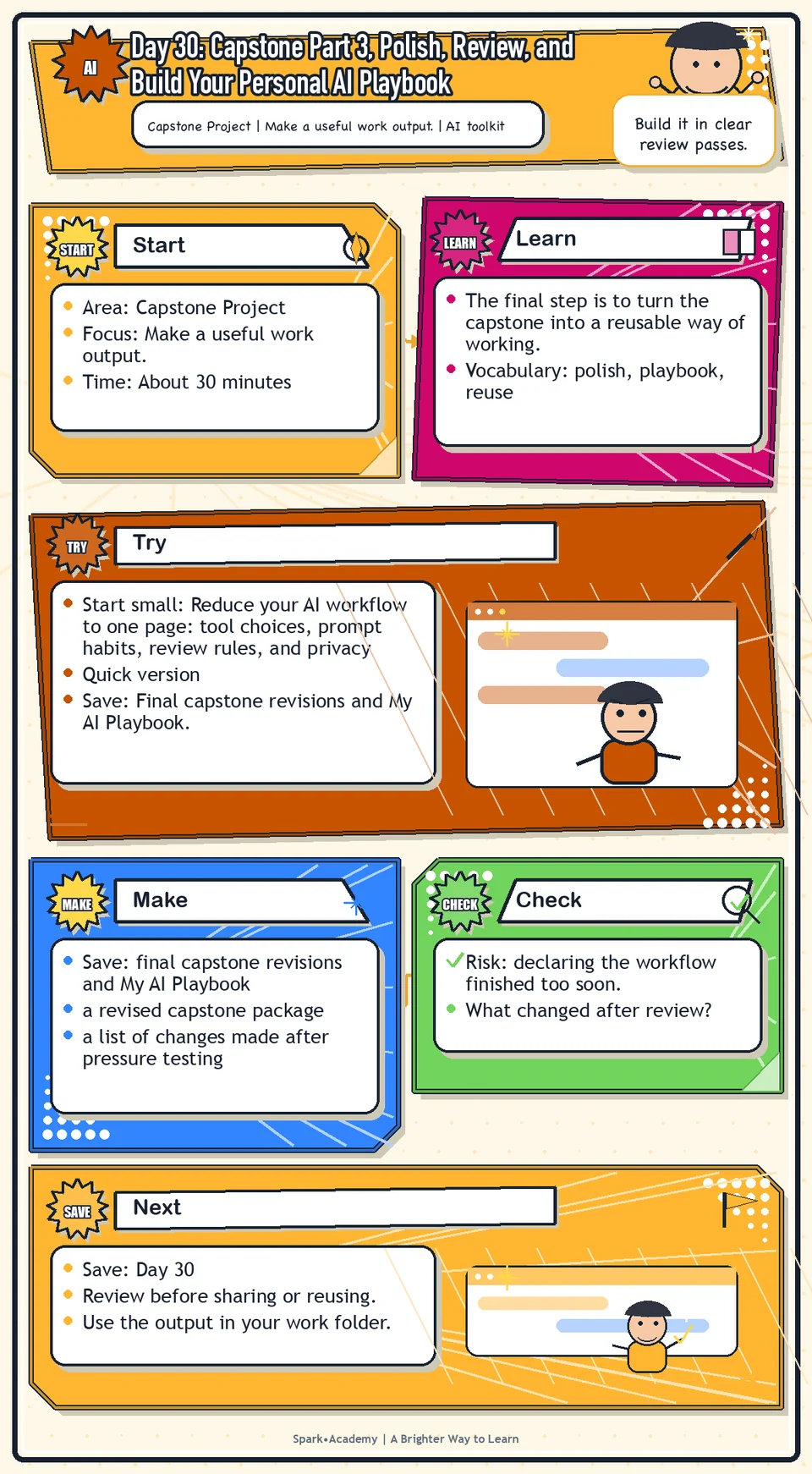
The final step is to turn the capstone into a reusable way of working. Your playbook should help you choose tools, prompt well, review answers, protect information, and decide what is ready for real use.
The lasting value is not the finished package alone. It is the judgment system around it: when to use AI, when not to, how to check it, how to protect information, and how to involve the right humans.
Save a short playbook you would actually use during a busy workday. It should include tool choices, prompt patterns, data boundaries, verification habits, review triggers, and warning signs.
Use the same scenario track from Days 28 and 29. Today is the quality pass: tighten the package, mark review needs, and turn the workflow into a personal playbook.
Know Before You Try
The final skill is judgment, not tool usage. A personal AI playbook turns that judgment into a repeatable workflow.
The playbook should answer five questions: When should I use each tool? What prompt patterns help? What information should I never paste? What review should I never skip? What needs human or expert review?
A useful playbook includes tool choices, prompt patterns, data boundaries, review habits, escalation points, and examples of outputs you trust. It should also include warning signs: when an answer sounds too confident, lacks sources, invents details, or needs expert review.
The playbook should help you compare outputs instead of accepting the first one. Sometimes the best result comes from using one tool to draft, another to summarize sources, and your own judgment to decide what belongs.
A good playbook is short, practical, and revisable. It should grow from real use, not freeze the challenge in place. Update it when tools change, your role changes, or you discover a better workflow.
Before you try
- Polish is more than making language smoother. It includes accuracy, structure, tone, accessibility, review readiness, and whether the final package can be used responsibly.
- Your personal AI playbook should be practical: favorite prompts, tool-selection rules, review checklists, privacy boundaries, and workflows you would actually repeat.
- End the challenge by noticing your judgment. The win is not that AI wrote things for you; the win is that you can guide, test, revise, and use AI with more confidence.
Where this helps
Use this after any major AI-assisted project and at the end of the regular work cycle.
- after any substantial AI-assisted project
- you want to review a package before sharing it
- you need a personal system for future AI use
Try It
Start small: Reduce your AI workflow to one page: tool choices, prompt habits, review rules, and privacy boundaries.
Quick version
- Save: Final capstone revisions and My AI Playbook.
- Minimum useful version: Revise the three-piece capstone package and create a one-page playbook with tools, prompts, review rules, and privacy boundaries.
- If stuck: Ask, "Would I use this playbook during a busy workday?" If not, cut it down.
- Done when: The final package is aligned and the playbook is simple enough to reuse after the challenge.
- Add only if useful: Add favorite prompts, warning signs, and examples of outputs you trust.
Aim for
- Playbook rule: "Use AI to start, structure, question, and review; do not use it as approval."
- Tool choice: ChatGPT for drafting, Gemini Notebook for source learning, Gemini for Workspace/web structure, ChatGPT Work for technical sensemaking.
- Review rule: "Before sharing, check facts, source support, tone, privacy, and human review needs."
- Why this works: It is short enough to use during a busy workday.
Practice
Use ChatGPT to pressure test the full capstone from the perspective of:
- Teammate.
- Technical reviewer.
- Subject-matter experts.
- Legal team.
- Customer-facing reader.
- Skeptical reader.
Revise the package. Create a note called "What I Learned From Comparing Tools." Create "My AI Playbook" with:
- When to use each tool.
- Best prompts.
- Review rules.
- Reusable workflows.
- Your Compare, Challenge, Combine method.
- What must always get human review.
End with: "AI helps me move faster, but my judgment decides what is ready to use."
Work in passes:
- Pressure test the full capstone package from several perspectives.
- Revise the package based on the strongest feedback.
- Create a playbook with tool uses, best prompts, review rules, workflows, and human review triggers.
- End with your personal responsible-use sentence.
If the playbook becomes too long, reduce it to one page: tools, best prompts, review checklist, and what needs human review. You can always expand later.
Before you save it:
- Do one final pass as the writer, one as the reviewer, and one as the future user of your playbook.
- Choose five prompts or rules from the challenge that you are most likely to reuse in real work.
Prompt
Primary Prompt
Use this to get a first useful draft.
Pressure test my full safe or mock capstone package from the perspective of a teammate, subject-matter reviewer, legal or privacy reviewer, skeptical reader, customer-facing reader, and technical reviewer. Then help me build My AI Playbook with tool uses, best prompts, review rules, workflows, Compare-Challenge-Combine, and human review rules.Role:
Act as a final reviewer and personal workflow coach.
Task:
Pressure test my full safe or mock capstone package from the perspective of a teammate, subject-matter reviewer, legal or privacy reviewer, skeptical reader, customer-facing reader, and technical reviewer. Then help me build My AI Playbook with tool uses, best prompts, review rules, workflows, Compare-Challenge-Combine, and human review rules.
Context:
- Keep in mind: The durable skill is judgment: compare outputs, challenge risks, revise intentionally, and decide what is ready for real use.
- Work context: capstone polish and personal AI playbook.
- Save as: final capstone revisions and AI playbook.
Use these details if I provide them:
- Full capstone package.
- Review feedback.
- Tools and prompts to reuse.
- Review rules.
Ask first only if needed:
- Ask up to three clarifying questions only when missing details would materially change the answer. Otherwise, proceed with clearly labeled assumptions or placeholders.
Keep it safe:
- Use only mock, public, sanitized, or workplace-approved information. Do not include sensitive, confidential, personal, customer, legal, financial, unreleased, private-code, credential, or regulated material unless that use is explicitly approved.
- Do not invent names, dates, metrics, source content, evidence, approvals, or promises. If details are missing, use labeled placeholders or a brief mock example.
How to work:
- Pressure test the full capstone.
- Build a personal AI playbook with tools, prompts, rules, workflows, Compare-Challenge-Combine, and human review triggers.
- End with a practical system.
Give me:
1. Pressure-test summary by reviewer type
2. Must-fix risks and unsupported claims
3. Revision priorities for the capstone package
4. One-page AI Playbook
5. Tool-use rules and reusable prompts
6. Human review and privacy boundaries
7. Compare-Challenge-Combine workflow
Style:
- Practical, clear, friendly, plain-English, specific, and non-hype.
- Use headings, bullets, or a compact table when that makes the output easier to scan.
Before you finish:
- The final answer should leave me with a system I can use again, not just a finished page.
- Make sure the answer is usable, grounded in provided or clearly labeled mock information, and clear about what needs human review before real use.Improve Prompt
Use this to turn review feedback into final edits.
Turn the pressure-test feedback on my capstone into a prioritized revision plan. Separate must-fix accuracy or review issues, should-fix clarity issues, optional polish, and days to add to My AI Playbook.Role:
Act as a capstone revision reviewer who turns feedback into prioritized fixes and playbook days.
Task:
Turn the pressure-test feedback on my capstone into a prioritized revision plan. Separate must-fix accuracy or review issues, should-fix clarity issues, optional polish, and days to add to My AI Playbook.
Context:
- Keep in mind: The durable skill is judgment: compare outputs, challenge risks, revise intentionally, and decide what is ready for real use.
- Work context: capstone polish and personal AI playbook.
- Save as: final capstone revisions and AI playbook.
Use these details if I provide them:
- Full capstone package.
- Review feedback.
- Tools and prompts to reuse.
- Review rules.
Ask first only if needed:
- Ask up to three clarifying questions only when missing details would materially change the answer. Otherwise, proceed with clearly labeled assumptions or placeholders.
Keep it safe:
- Use only mock, public, sanitized, or workplace-approved information. Do not include sensitive, confidential, personal, customer, legal, financial, unreleased, private-code, credential, or regulated material unless that use is explicitly approved.
- Do not invent names, dates, metrics, source content, evidence, approvals, or promises. If details are missing, use labeled placeholders or a brief mock example.
How to work:
- Turn pressure-test feedback into prioritized revisions.
- Separate must-fix, should-fix, optional polish, and playbook days.
- Make revision steps clear.
Give me:
1. Quick verdict
2. Issue table with priority, evidence, and recommended fix
3. Revised draft or targeted rewrite
4. Questions or approvals still needed
5. Before-use review checklist
6. Reusable review prompt pattern
Style:
- Practical, clear, friendly, plain-English, specific, and non-hype.
- Use headings, bullets, or a compact table when that makes the output easier to scan.
Before you finish:
- The final answer should leave me with a system I can use again, not just a finished page.
- Make sure the answer is usable, grounded in provided or clearly labeled mock information, and clear about what needs human review before real use.Apply Prompt
Use this to make the playbook usable after the challenge.
Help me reduce My AI Playbook to one practical page. Include when to use each tool, five prompts I will reuse, review rules I should never skip, privacy boundaries, and my Compare-Challenge-Combine workflow.Role:
Act as a practical AI-playbook coach who helps me reduce my workflow into a one-page system I can reuse.
Task:
Help me reduce My AI Playbook to one practical page. Include when to use each tool, five prompts I will reuse, review rules I should never skip, privacy boundaries, and my Compare-Challenge-Combine workflow.
Context:
- Keep in mind: The durable skill is judgment: compare outputs, challenge risks, revise intentionally, and decide what is ready for real use.
- Work context: capstone polish and personal AI playbook.
- Save as: final capstone revisions and AI playbook.
Use these details if I provide them:
- Full capstone package.
- Review feedback.
- Tools and prompts to reuse.
- Review rules.
Ask first only if needed:
- Ask up to three clarifying questions only when missing details would materially change the answer. Otherwise, proceed with clearly labeled assumptions or placeholders.
Keep it safe:
- Use only mock, public, sanitized, or workplace-approved information. Do not include sensitive, confidential, personal, customer, legal, financial, unreleased, private-code, credential, or regulated material unless that use is explicitly approved.
- Do not invent names, dates, metrics, source content, evidence, approvals, or promises. If details are missing, use labeled placeholders or a brief mock example.
How to work:
- Reduce the playbook to one practical page.
- Include tool choices, five reusable prompts, review rules, privacy boundaries, and workflow.
- Keep it usable during a busy work period.
Give me:
1. Questions to ask me first
2. Safe assumptions if I do not answer yet
3. One-page AI Playbook
4. Tool-selection rules
5. Five reusable prompts
6. Review and privacy rules
7. Compare-Challenge-Combine workflow
8. Maintenance note
Style:
- Practical, clear, friendly, plain-English, specific, and non-hype.
- Use headings, bullets, or a compact table when that makes the output easier to scan.
Before you finish:
- The final answer should leave me with a system I can use again, not just a finished page.
- Make sure the answer is usable, grounded in provided or clearly labeled mock information, and clear about what needs human review before real use.Make Something Useful
Save the final reusable record of your workflow, judgment habits, and personal AI rules.
Save final capstone revisions and My AI Playbook.
Make sure it includes:
- a revised capstone package
- a list of changes made after pressure testing
- a simple AI playbook
- clear rules for privacy, accuracy, review, and tool choice
Review and Save
Specific risk to check: The risk today is declaring the workflow finished too soon. The final package still needs accuracy, review flags, privacy boundaries, and a playbook you will actually reuse.
Review the capstone as if someone important will read it. Check accuracy, source support, tone, risk, review needs, and audience fit.
Ask yourself:
- What changed after review?
- What still needs a human reviewer?
- Which prompts were most useful?
- Can I use this playbook during a real busy work period?
Watch for
The playbook should stay simple. If it becomes too complicated, it will not be used. Keep it practical and revise it after real work begins.
Do not make the playbook so elaborate that it becomes homework. The value is in having a small set of rules you can actually remember and use.
Save
Save this in your 30-day work folder as Day 30 - final capstone revisions and My AI Playbook.
Add a quick reuse note: Use this at work for: reviewing a final AI-assisted project and keeping a personal playbook you can reuse during real work.
Save the playbook where you can find it quickly. This is the challenge's final durable asset.
Check yourself
- I pressure tested the full capstone package.
- I revised the final outputs.
- I marked what needs human review.
- I created a note about what I learned from comparing tools.
- I created my personal AI playbook.
- I can explain how I would use these tools during my busy work period.
- I can describe my personal AI workflow from source gathering through final review.
- I can carry this workflow into future work through a practical AI playbook and review habit.