Day 9: Produce a Project Framing and Question Set
What you will learn and leave with
This lesson teaches you how to produce a project framing and question set. It uses ChatGPT as a practical learning context while keeping privacy, accuracy, context, and human judgment in charge.
Use this when: you want to create a practical, reviewable work output with ChatGPT. By the end: you will save project framing and stakeholder question set.
Course position: Day 9 of 30 · ChatGPT module
Continue: Day 10: Use ChatGPT for Pressure Testing and Claim Discipline
Source check: product features and interfaces can change. OpenAI ChatGPT Help Center was checked for this course on 2026-08-30; confirm current details before using a changing feature.
Listen to the Day 9 Introduction
This short audio introduces the day and what to focus on.
Day 9: Produce a Project Framing and Question Set audio transcript
Before a project becomes a full draft, it often needs something smaller: a clear frame that people can react to.
That frame can save time, because it lets you test the direction before you polish the wrong thing.
Welcome to Day 9 of the 30-Day AI at Work Challenge: Produce a Project Framing and Question Set.
Today, you will turn possible ideas into a useful project framing. A framing is not just a headline. It is a testable story hypothesis.
That means it says, "This might be the right angle for this audience, for these reasons, with this proof, and these questions still open."
Here is why that matters. Vague ideas often move too quickly into polished drafts. Once something sounds finished, people may react to the wording instead of the underlying direction. A good framing keeps the conversation earlier and more useful.
You will practice naming the audience, the working angle, the proof needed, the risks, and the questions to ask before drafting.
The risk today is treating the framing as a fact. It is not a fact yet. It is a direction to test.
So listen for support. What do you actually know? What is still an assumption? What would a stakeholder need to confirm before this angle becomes messaging?
Before you enter the lesson, think about a topic where several stories could be true. Which audience are you serving? What would they need to believe, understand, or decide?
By the end, you will save a project framing and stakeholder question set. If someone could read it and have a sharper review conversation, you are on the right track.
Why It Matters
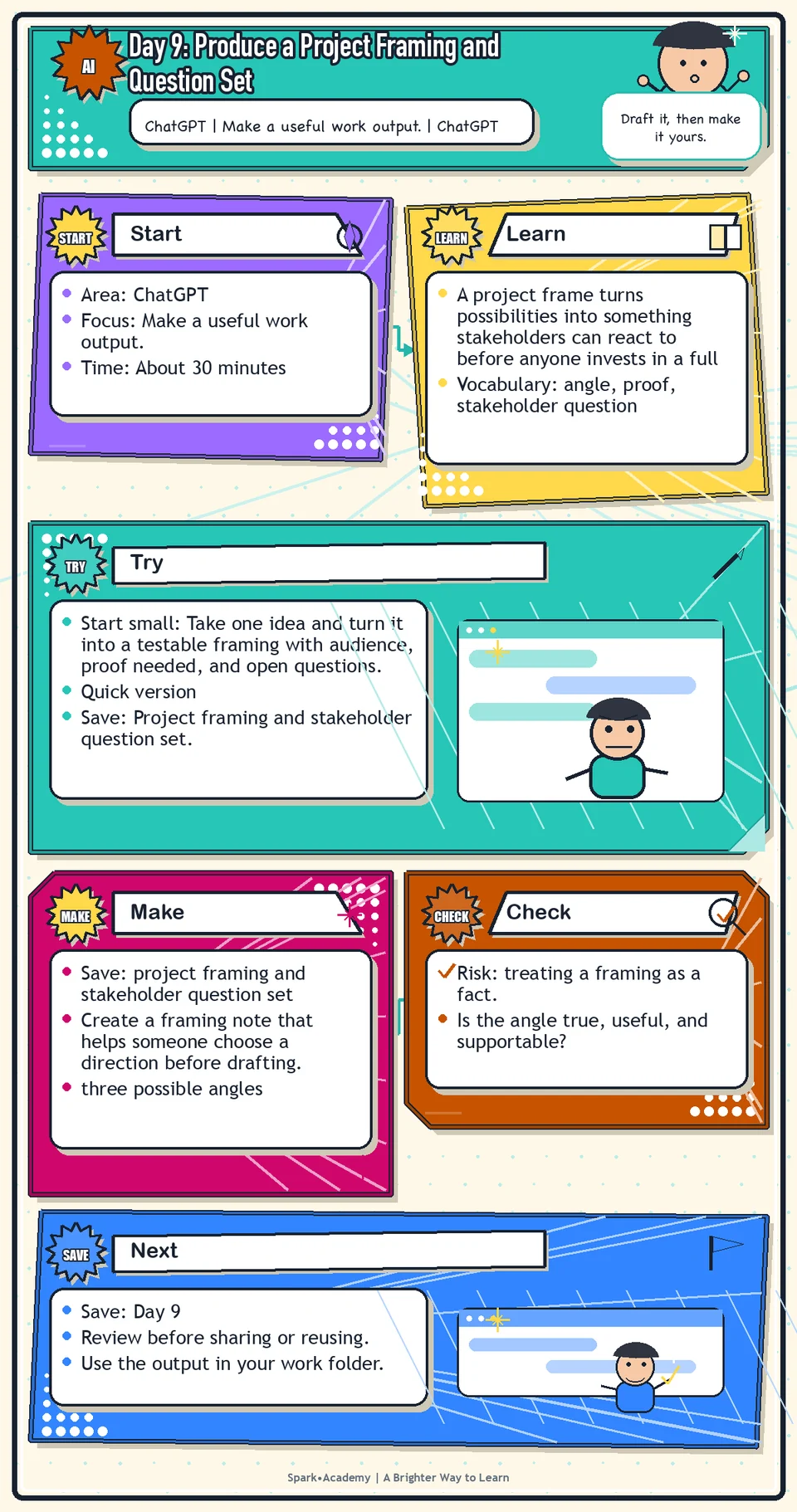
A project frame turns possibilities into something stakeholders can react to before anyone invests in a full draft. It names the working angle, audience, rationale, assumptions, risks, proof needs, and questions.
This matters because vague ideas often move too quickly into polished language. A framing note creates a checkpoint where others can challenge the direction, add missing context, correct assumptions, and clarify what success should look like.
Save a frame that is specific enough to test and flexible enough to revise. It should make the hypothesis, evidence needs, uncertainties, and decision points visible.
Know Before You Try
A project framing is a testable story hypothesis. It explains what the work is about, who it is for, why it matters, what angle might work, what proof supports it, and what still needs to be answered.
The angle is not final messaging. It says, "This may be the clearest way to frame the story, and here is what we still need to confirm." Treating it as a hypothesis prevents premature polish.
A strong framing includes five parts: audience need, truthful claim, reason now, supporting proof, and known risk. If any part is weak, the draft will probably be weak too.
The question set is the test plan. It surfaces missing evidence, possible misunderstandings, stakeholder concerns, review needs, and decisions that affect the final message.
The value of the note is not that it is right on the first try. It gives stakeholders something concrete to react to before the team invests in a full draft.
Before you try
- A project framing is not just a headline. It is a choice about what matters most to this audience right now.
- Strong angles connect audience need, business context, proof, timing, and risk. Weak angles sound polished but could fit almost any topic.
- A good question set should uncover facts, limitations, stakeholder concerns, and what the workplace is not ready to say yet.
Where this helps
Use this when a message is still forming and you need to prepare for discussions with subject-matter, legal, technical, customer-facing, or other partners.
- planning a rollout message, FAQ, team update, or briefing
- several possible stories compete for attention
- you need to bring sharper questions to subject-matter, legal, privacy, compliance, or other appropriate review
Try It
Start small: Take one idea and turn it into a testable framing with audience, proof needed, and open questions.
Quick version
- Save: Project framing and stakeholder question set.
- Minimum useful version: Write one selected angle with audience, rationale, proof needed, risks, and five stakeholder questions.
- If stuck: "Angle: this update helps teams understand what is changing, why it matters, and what still needs review."
- Done when: The frame is clear enough for someone to challenge before you draft the full message.
- Add only if useful: Add one weak version and one stronger version so you can see what improved.
Aim for
- Working angle: "The update is about making support information easier to understand, not replacing human support."
- Audience: Internal review team.
- Risk: The message could imply customer outcomes that have not been proven.
- Stakeholder question: "What evidence can we safely use, and what language needs approval?"
Practice
Choose one topic:
- Product update.
- AI feature or workflow change.
- Team update.
- Media inquiry.
- point of view.
Ask ChatGPT to create three project framings. For each one, include:
- Audience.
- Why the angle matters.
- Proof needed.
- Possible risks.
- Questions to ask before using it.
Select one angle and refine it into a short planning note. End the note with the questions you would bring to stakeholders.
Work in passes:
- Choose three possible angles.
- For each angle, write who it serves and what proof it would need.
- Ask ChatGPT to identify risks, weak spots, and likely stakeholder questions.
- Select one angle and explain why it is strongest.
If every angle sounds promotional, ask for a more grounded version focused on usefulness, clarity, or reader questions. In product, trust often comes from precision, not hype.
Before you save it:
- Create at least three possible angles, then reject one and explain why it is weaker.
- Sort your questions into fact questions, judgment questions, and approval questions.
Prompt
Primary Prompt
Use this to get a first useful draft.
Help me create three project framings for a safe or mock product update. For each angle, include audience, importance, proof needed, risks, and questions to ask before using it. Then help me select and refine the strongest one.Role:
Act as a planning partner who thinks about audience and proof.
Task:
Help me create three project framings for a safe or mock product update. For each angle, include audience, importance, proof needed, risks, and questions to ask before using it. Then help me select and refine the strongest one.
Context:
- Keep in mind: A project framing is a working hypothesis that connects audience, message, proof, risk, and stakeholder questions before final messaging.
- Work context: turning brainstorms into project planning.
- Save as: project framing and stakeholder question set.
Use these details if I provide them:
- Safe topic.
- Intended audience.
- Possible claims.
- Available proof.
- Review stakeholders.
Ask first only if needed:
- Ask up to three clarifying questions only when missing details would materially change the answer. Otherwise, proceed with clearly labeled assumptions or placeholders.
Keep it safe:
- Use only mock, public, sanitized, or workplace-approved information. Do not include sensitive, confidential, personal, customer, legal, financial, unreleased, private-code, credential, or regulated material unless that use is explicitly approved.
- Do not invent names, dates, metrics, source content, evidence, approvals, or promises. If details are missing, use labeled placeholders or a brief mock example.
How to work:
- Create three possible framings as hypotheses.
- Connect each angle to audience, proof, and risk.
- Select the strongest angle and refine it.
Give me:
1. Three framings
2. Proof and risks
3. Questions before use
4. Selected angle
5. Planning note
Style:
- Practical, clear, friendly, plain-English, specific, and non-hype.
- Use headings, bullets, or a compact table when that makes the output easier to scan.
Before you finish:
- The framing should be specific enough to discuss and cautious enough to review.
- Make sure the answer is usable, grounded in provided or clearly labeled mock information, and clear about what needs human review before real use.Improve Prompt
Use this to prepare the framing for stakeholder discussion.
Pressure test my selected project framing. Identify what evidence it needs, what a skeptical stakeholder might challenge, what wording could overpromise, and which questions should go to subject-matter, legal, privacy, compliance, or technical reviewers.Role:
Act as a project-framing reviewer who tests the angle, proof needs, risks, and stakeholder questions.
Task:
Pressure test my selected project framing. Identify what evidence it needs, what a skeptical stakeholder might challenge, what wording could overpromise, and which questions should go to subject-matter, legal, privacy, compliance, or technical reviewers.
Context:
- Keep in mind: A project framing is a working hypothesis that connects audience, message, proof, risk, and stakeholder questions before final messaging.
- Work context: turning brainstorms into project planning.
- Save as: project framing and stakeholder question set.
Use these details if I provide them:
- Safe topic.
- Intended audience.
- Possible claims.
- Available proof.
- Review stakeholders.
Ask first only if needed:
- Ask up to three clarifying questions only when missing details would materially change the answer. Otherwise, proceed with clearly labeled assumptions or placeholders.
Keep it safe:
- Use only mock, public, sanitized, or workplace-approved information. Do not include sensitive, confidential, personal, customer, legal, financial, unreleased, private-code, credential, or regulated material unless that use is explicitly approved.
- Do not invent names, dates, metrics, source content, evidence, approvals, or promises. If details are missing, use labeled placeholders or a brief mock example.
How to work:
- Pressure test the selected framing.
- Identify evidence needed, skeptical challenges, and overpromising language.
- Sort reviewer questions by role.
Give me:
1. Quick verdict
2. Issue table with priority, evidence, and recommended fix
3. Revised draft or targeted rewrite
4. Questions or approvals still needed
5. Before-use review checklist
6. Reusable review prompt pattern
Style:
- Practical, clear, friendly, plain-English, specific, and non-hype.
- Use headings, bullets, or a compact table when that makes the output easier to scan.
Before you finish:
- The framing should be specific enough to discuss and cautious enough to review.
- Make sure the answer is usable, grounded in provided or clearly labeled mock information, and clear about what needs human review before real use.Apply Prompt
Use this to turn a rough idea into a planning note.
Ask me for a safe, approved, or mock project topic and intended audience. Then help me create a one-page planning note with selected angle, rationale, proof needed, risks, rejected alternatives, and stakeholder questions.Role:
Act as a practical project-framing coach who helps me turn a safe topic into a one-page planning note.
Task:
Ask me for a safe, approved, or mock project topic and intended audience. Then help me create a one-page planning note with selected angle, rationale, proof needed, risks, rejected alternatives, and stakeholder questions.
Context:
- Keep in mind: A project framing is a working hypothesis that connects audience, message, proof, risk, and stakeholder questions before final messaging.
- Work context: turning brainstorms into project planning.
- Save as: project framing and stakeholder question set.
Use these details if I provide them:
- Safe topic.
- Intended audience.
- Possible claims.
- Available proof.
- Review stakeholders.
Ask first only if needed:
- Ask up to three clarifying questions only when missing details would materially change the answer. Otherwise, proceed with clearly labeled assumptions or placeholders.
Keep it safe:
- Use only mock, public, sanitized, or workplace-approved information. Do not include sensitive, confidential, personal, customer, legal, financial, unreleased, private-code, credential, or regulated material unless that use is explicitly approved.
- Do not invent names, dates, metrics, source content, evidence, approvals, or promises. If details are missing, use labeled placeholders or a brief mock example.
How to work:
- Ask for a safe or mock topic and audience.
- Create a one-page planning note.
- Include selected angle, rationale, proof, risks, rejected alternatives, and questions.
Give me:
1. Questions to ask me first
2. Safe assumptions if I do not answer yet
3. Adapted project framing and stakeholder question set
4. Review before real use
5. Reusable prompt pattern
Style:
- Practical, clear, friendly, plain-English, specific, and non-hype.
- Use headings, bullets, or a compact table when that makes the output easier to scan.
Before you finish:
- The framing should be specific enough to discuss and cautious enough to review.
- Make sure the answer is usable, grounded in provided or clearly labeled mock information, and clear about what needs human review before real use.Make Something Useful
Create a framing note that helps someone choose a direction before drafting.
Save project framing and stakeholder question set.
Make sure it includes:
- three possible angles
- proof needed for each angle
- risks or misunderstandings for each angle
- a final selected angle with a short rationale
- stakeholder questions that would improve or validate the direction
Review and Save
Specific risk to check: The risk today is treating a framing as a fact. A useful angle is still a hypothesis until proof, stakeholder input, and review support it.
Ask whether the audience is specific, the value is clear, the proof points are real, the risk is visible, and the questions are useful enough to guide a meeting.
Ask yourself:
- Is the angle true, useful, and supportable?
- Does it serve the audience or mainly serve the workplace?
- What would a skeptical reader ask?
- What evidence would I need before using this in a public or team-facing context?
Watch for
A strong angle is not the same as an approved message. It is a working hypothesis. Treat it as something to test, not something to publish.
Do not fall in love with the cleverest angle. The best angle is the one that can survive review, answer real reader questions, and stay close to the truth.
Save
Save this in your 30-day work folder as Day 9 - project framing and stakeholder question set.
Add a quick reuse note: Use this at work for: framing a project, rollout, announcement, or point of view before investing in a full draft.
Save both the selected angle and the rejected alternatives. The alternatives may help later if the direction changes.
Check yourself
- I chose a realistic workplace topic.
- I created three possible project framings.
- I identified what proof would be needed for each angle.
- I identified possible risks or weak spots.
- I created questions to ask before using the angle.
- I selected the strongest angle and explained why.
- I can explain what evidence my chosen angle would need before it became a real message.
- I can use a framing note to test a project angle before drafting a message or plan.