Day 15: Use Gemini Notebook for Topic Based Learning
What you will learn and leave with
This lesson teaches you how to use Gemini Notebook for topic based learning. It uses Gemini Notebook as a practical learning context while keeping privacy, accuracy, context, and human judgment in charge.
Use this when: you want guided practice with Gemini Notebook before applying it to real work. By the end: you will save Future Notebooks note and one topic-based notebook plan.
Course position: Day 15 of 30 · Gemini Notebook module
Continue: Day 16: Produce a Source Based Notebook Summary
Source check: product features and interfaces can change. Gemini Notebook Help Center was checked for this course on 2026-08-30; confirm current details before using a changing feature.
Listen to the Day 15 Introduction
This short audio introduces the day and what to focus on.
Day 15: Use Gemini Notebook for Topic Based Learning audio transcript
Learning a new work topic can feel like opening ten tabs and hoping the important parts reveal themselves.
Today, you will practice a better way.
Welcome to Day 15 of the 30-Day AI at Work Challenge: Use Gemini Notebook for Topic Based Learning.
The focus today is building a topic-based notebook. Think of it as a learning container with a purpose. It should have a clear question, a clear source boundary, and a simple way to save useful notes.
Here is why this matters. Workplace learning often happens while work is already moving. You may need to understand a product area, a policy topic, a competitor, a project history, or a technical concept quickly enough to ask better questions.
Gemini Notebook can help, but only if the notebook is built with care.
The risk today is source gaps. If important sources are missing, stale, or one-sided, the notebook's answers will reflect that. Source-grounded does not mean complete.
So before you ask for summaries, ask what belongs in the notebook and what does not. Then ask questions that help you understand the topic in layers: key terms, major themes, open questions, and what someone new should know first.
In the lesson, you will build a topic notebook plan. You will decide what the notebook is for, what sources belong, what questions you would ask often, and what outputs might be useful later.
Before you begin, think of one topic you keep returning to. If you had a notebook for it, what would you want that notebook to help you do?
By the end, you will save a future notebook note and one topic-based notebook plan.
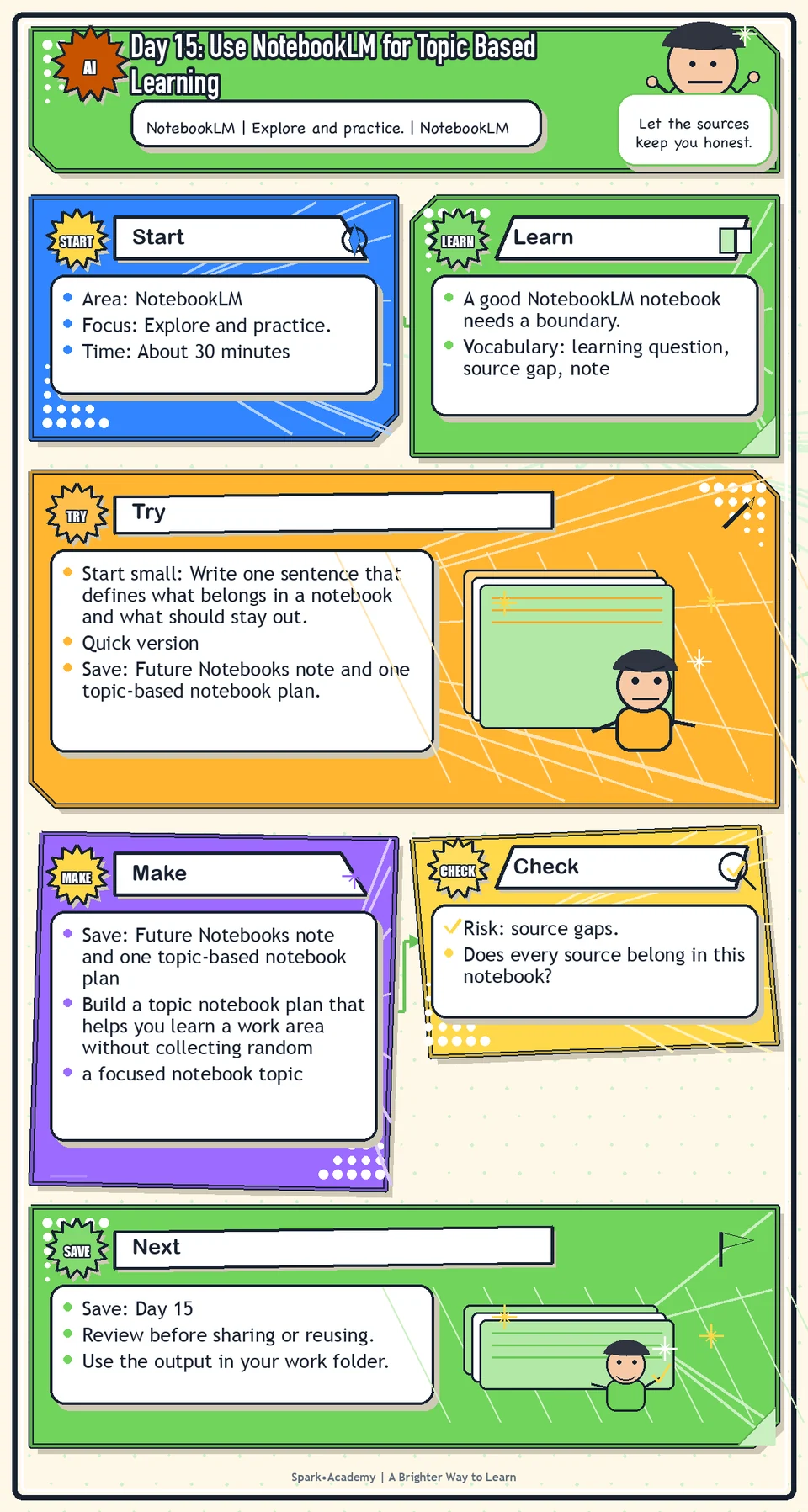
Why It Matters
A good Gemini Notebook notebook needs a boundary. Instead of collecting everything, define what the notebook is for, what belongs in it, and what kind of work it should help you do.
Focused notebooks keep project context, domain learning, public sources, internal material, and communication planning from blending together. They make answers easier to trust and maintain.
Save a topic notebook plan that passes this sentence test: "This notebook helps me learn about X so I can do Y." Include what belongs, what does not, and the first questions worth asking.
Know Before You Try
A topic-based notebook is a learning container with a purpose. It is not a folder for everything related to a broad subject.
Use the sentence test: "This notebook helps me learn about X so I can do Y." If you cannot finish that sentence clearly, the notebook may be too broad, too vague, or not connected to real work.
The topic defines the source boundary. It tells you what belongs, what does not belong, and what should become a separate notebook. A good title should make that boundary obvious.
Topic-based learning is iterative. Add sources, ask questions, create learning aids, notice gaps, and decide whether the notebook needs better material or a tighter scope.
The point is not to collect everything. The point is to create a focused learning space that helps you explain the topic, ask better questions, and use the knowledge later.
Before you try
- Topic-based learning works best when the notebook has a clear learning question, a source boundary, and a repeatable note-taking pattern.
- Do not confuse source-grounded with complete. Gemini Notebook can only work from the sources available in the notebook, so gaps in the source set become gaps in the answer.
- Use a question ladder: start with 'What is this about?', then ask 'How does it work?', 'What matters most?', 'What is uncertain?', and 'What should I ask next?'
Where this helps
Use this when learning a new domain, preparing for getting oriented, tracking competitors, studying a product area, or organizing workplace narrative work.
- starting a new domain or project area
- you expect to return to the same sources over time
- you want to build a reusable learning base instead of one-off summaries
Try It
Start small: Write one sentence that defines what belongs in a notebook and what should stay out.
Quick version
- Save: Future Notebooks note and one topic-based notebook plan.
- Minimum useful version: Name one notebook, finish the sentence test, and list three sources that belong and two that do not.
- If stuck: "This notebook helps me learn about customer support terminology so I can ask better review questions."
- Done when: The notebook boundary is clear enough that unrelated sources are easy to reject.
- Add only if useful: Add rules for when to split a notebook into two smaller notebooks.
Aim for
- Sentence test: "This notebook helps me learn about customer support terminology so I can ask better review questions."
- Sources that belong: Approved glossary, public product help page, source-based FAQ.
- Sources that do not belong: Competitor news, unrelated meeting notes, broad AI trend articles.
- Why this works: The boundary keeps the notebook useful instead of turning it into a dumping ground.
Practice
In the Work Reference notebook, create a note called "Future Notebooks." List possible notebooks:
- Domain AI.
- Product and Technology.
- Workplace Narrative.
- Competitors.
- Media Strategy.
- Messaging and Positioning.
- Customer Experience.
- Regulatory and Trust Questions.
For each possible notebook, add one sentence explaining why it might be useful. Then create one additional notebook from the list and write what sources would belong there.
Work in passes:
- Choose one learning topic.
- Write the purpose of the notebook in one sentence.
- Add or list sources that belong in the notebook.
- Ask Gemini Notebook for a learning path, glossary, or key questions based on the sources.
If the topic feels too broad, split it. "Workplace AI" could become "AI in customer support workflows" or "AI terminology I need for product conversations."
Before you save it:
- After the first answer, ask Gemini Notebook what source gaps could limit the answer.
- Save one note that captures both what you learned and what you still need to verify.
Prompt
Primary Prompt
Use this to get a first useful draft.
Help me plan topic-based Gemini Notebook notebooks for Domain AI, Product and Technology, Workplace Narrative, Competitors, Media Strategy, Messaging and Positioning, Customer Experience, and Trust and Risk Questions. For each, explain why it may be useful and what sources belong there.Role:
Act as a learning-system designer.
Task:
Help me plan topic-based Gemini Notebook notebooks for Domain AI, Product and Technology, Workplace Narrative, Competitors, Media Strategy, Messaging and Positioning, Customer Experience, and Trust and Risk Questions. For each, explain why it may be useful and what sources belong there.
Context:
- Keep in mind: Focused notebooks produce better questions, cleaner summaries, and more reusable learning than broad notebooks with unclear purpose.
- Work context: topic-based Gemini Notebook organization.
- Save as: topic-based notebook map.
Use these details if I provide them:
- Topics to learn.
- Source types.
- Update rhythm.
- Audience for learning.
Ask first only if needed:
- Ask up to three clarifying questions only when missing details would materially change the answer. Otherwise, proceed with clearly labeled assumptions or placeholders.
Keep it safe:
- Use only mock, public, sanitized, or workplace-approved information. Do not include sensitive, confidential, personal, customer, legal, financial, unreleased, private-code, credential, or regulated material unless that use is explicitly approved.
- Do not invent names, dates, metrics, source content, evidence, approvals, or promises. If details are missing, use labeled placeholders or a brief mock example.
How to work:
- Plan notebooks by topic and purpose.
- Explain what sources belong in each.
- Include recurring questions.
Give me:
1. Notebook list
2. Purpose of each notebook
3. Sources to include
4. Recurring questions
5. Overlap or merge notes
6. Maintenance rule
Style:
- Practical, clear, friendly, plain-English, specific, and non-hype.
- Use headings, bullets, or a compact table when that makes the output easier to scan.
Before you finish:
- The notebook map should be simple enough to maintain.
- Make sure the answer is usable, grounded in provided or clearly labeled mock information, and clear about what needs human review before real use.Improve Prompt
Use this to avoid messy notebook sprawl.
Review this topic-based notebook plan. Identify notebooks that overlap, sources that belong in more than one place, topics that are too broad, and questions that should be asked inside each notebook before relying on its answers.Role:
Act as a notebook-organization reviewer who checks topic focus, source overlap, and question quality.
Task:
Review this topic-based notebook plan. Identify notebooks that overlap, sources that belong in more than one place, topics that are too broad, and questions that should be asked inside each notebook before relying on its answers.
Context:
- Keep in mind: Focused notebooks produce better questions, cleaner summaries, and more reusable learning than broad notebooks with unclear purpose.
- Work context: topic-based Gemini Notebook organization.
- Save as: topic-based notebook map.
Use these details if I provide them:
- Topics to learn.
- Source types.
- Update rhythm.
- Audience for learning.
Ask first only if needed:
- Ask up to three clarifying questions only when missing details would materially change the answer. Otherwise, proceed with clearly labeled assumptions or placeholders.
Keep it safe:
- Use only mock, public, sanitized, or workplace-approved information. Do not include sensitive, confidential, personal, customer, legal, financial, unreleased, private-code, credential, or regulated material unless that use is explicitly approved.
- Do not invent names, dates, metrics, source content, evidence, approvals, or promises. If details are missing, use labeled placeholders or a brief mock example.
How to work:
- Find overlap, overly broad topics, and source confusion.
- Recommend merges, splits, or naming changes.
- Add questions to ask inside each notebook.
Give me:
1. Quick verdict
2. Issue table with priority, evidence, and recommended fix
3. Revised draft or targeted rewrite
4. Questions or approvals still needed
5. Before-use review checklist
6. Reusable review prompt pattern
Style:
- Practical, clear, friendly, plain-English, specific, and non-hype.
- Use headings, bullets, or a compact table when that makes the output easier to scan.
Before you finish:
- The notebook map should be simple enough to maintain.
- Make sure the answer is usable, grounded in provided or clearly labeled mock information, and clear about what needs human review before real use.Apply Prompt
Use this to build a personal notebook system.
Ask me about the topics I need to learn for work. Then suggest five to eight Gemini Notebook notebooks, the safe source types for each, recurring questions, and rules for when to create a new notebook instead of adding to an old one.Role:
Act as a practical learning-system coach who helps me organize recurring work topics into focused notebooks.
Task:
Ask me about the topics I need to learn for work. Then suggest five to eight Gemini Notebook notebooks, the safe source types for each, recurring questions, and rules for when to create a new notebook instead of adding to an old one.
Context:
- Keep in mind: Focused notebooks produce better questions, cleaner summaries, and more reusable learning than broad notebooks with unclear purpose.
- Work context: topic-based Gemini Notebook organization.
- Save as: topic-based notebook map.
Use these details if I provide them:
- Topics to learn.
- Source types.
- Update rhythm.
- Audience for learning.
Ask first only if needed:
- Ask up to three clarifying questions only when missing details would materially change the answer. Otherwise, proceed with clearly labeled assumptions or placeholders.
Keep it safe:
- Use only mock, public, sanitized, or workplace-approved information. Do not include sensitive, confidential, personal, customer, legal, financial, unreleased, private-code, credential, or regulated material unless that use is explicitly approved.
- Do not invent names, dates, metrics, source content, evidence, approvals, or promises. If details are missing, use labeled placeholders or a brief mock example.
How to work:
- Ask about topics and source needs.
- Suggest five to eight maintainable notebooks.
- Define when to create a new notebook.
Give me:
1. Questions to ask me first
2. Safe assumptions if I do not answer yet
3. Adapted topic-based notebook map
4. Review before real use
5. Reusable prompt pattern
Style:
- Practical, clear, friendly, plain-English, specific, and non-hype.
- Use headings, bullets, or a compact table when that makes the output easier to scan.
Before you finish:
- The notebook map should be simple enough to maintain.
- Make sure the answer is usable, grounded in provided or clearly labeled mock information, and clear about what needs human review before real use.Make Something Useful
Build a topic notebook plan that helps you learn a work area without collecting random material.
Save Future Notebooks note and one topic-based notebook plan.
Make sure it includes:
- a focused notebook topic
- a source list or added sources
- a short note on what this notebook should help you understand or do
- initial questions, glossary terms, or study notes from the notebook
Review and Save
Specific risk to check: The risk today is source gaps. Gemini Notebook can only answer from what you provide, so missing, stale, or one-sided sources become missing, stale, or one-sided learning.
Ask whether each notebook has a clear purpose and whether the sources belong together.
Ask yourself:
- Does every source belong in this notebook?
- What source perspectives are missing?
- Can I explain what this notebook is for?
- Would another person understand the topic boundary from the title?
Watch for
Too many notebooks can become clutter. Start with a few useful ones and add more only when a topic deserves its own space.
Do not build a giant notebook just because you can. Smaller notebooks are often easier to trust, update, and use.
Save
Save this in your 30-day work folder as Day 15 - Future Notebooks note and one topic-based notebook plan.
Add a quick reuse note: Use this at work for: deciding what belongs in a topic notebook before a project, research task, or stakeholder conversation.
Save the notebook title, purpose sentence, and source list in your work folder. This becomes the start of your Gemini Notebook system.
Check yourself
- I created a list of possible future notebooks.
- I understand why each notebook should have a clear topic.
- I created or planned one topic-based notebook.
- I considered which sources belong in that notebook.
- I understand that too many unfocused notebooks can become clutter.
- I know how topic-based notebooks can support getting oriented.
- I can define the topic boundary for my notebook in one clear sentence.
- I can design a topic notebook that says what belongs, what does not, and what it helps me do.
Optional video
Watch: How to Master Complex Research with Gemini Notebook | Help Not Hype (official Google Workspace YouTube channel, 1:32).
Why it helps: It reinforces Gemini Notebook as a tool for working through complex source material with more structure.