Day 28: Capstone Part 1, Build the Source and Strategy Foundation
What you will learn and leave with
This lesson focuses on capstone part 1, build the source and strategy foundation. It uses Capstone Project as a practical context while keeping privacy, accuracy, context, and human judgment in charge.
Use this when: you need a practical, reviewable next step. By the end: you will save source and strategy foundation for the capstone.
Source check: product features and interfaces can change. NIST AI Risk Management Framework was checked for this course on 2026-08-19; confirm current details before using a changing feature.
Listen to the Day 28 Introduction
This short audio introduces the day and what to focus on.
Day 28: Capstone Part 1, Build the Source and Strategy Foundation audio transcript
When a project matters, the story should not move faster than the facts.
That is the heart of the capstone.
Welcome to Day 28 of the 30-Day AI at Work Challenge: Capstone Part 1, Build the Source and Strategy Foundation.
Today, you begin the final three-day project. You will choose one realistic scenario track and build the factual spine before drafting anything polished.
You have three tracks to choose from. An internal rollout, where a team is piloting an AI-assisted workflow. A customer-facing FAQ, where a change may eventually need public explanation. Or a technical feature explanation, where a technical capability needs to become clear for nontechnical stakeholders.
Whichever track you choose, stay with it through Day 30. That will keep the capstone coherent.
Let's start with the main idea. A strong communication package starts with sources, audience, goal, claims, risks, open questions, and review needs. If those pieces are blurry, AI can still produce polished drafts, but the drafts may rest on assumptions.
That is today's risk: assumptions hardening into the story.
In the lesson, you will collect or create safe source material, summarize what the sources support, identify the audience and goal, and mark what still needs review. You may use Gemini Notebook for source grounding, ChatGPT for strategy, Gemini for web or Workspace thinking, and ChatGPT Work for technical translation if needed.
Before you begin, ask yourself: What is actually supported, and what am I only assuming?
By the end, you will save the source and strategy foundation for your capstone. It is the anchor for everything you build next.
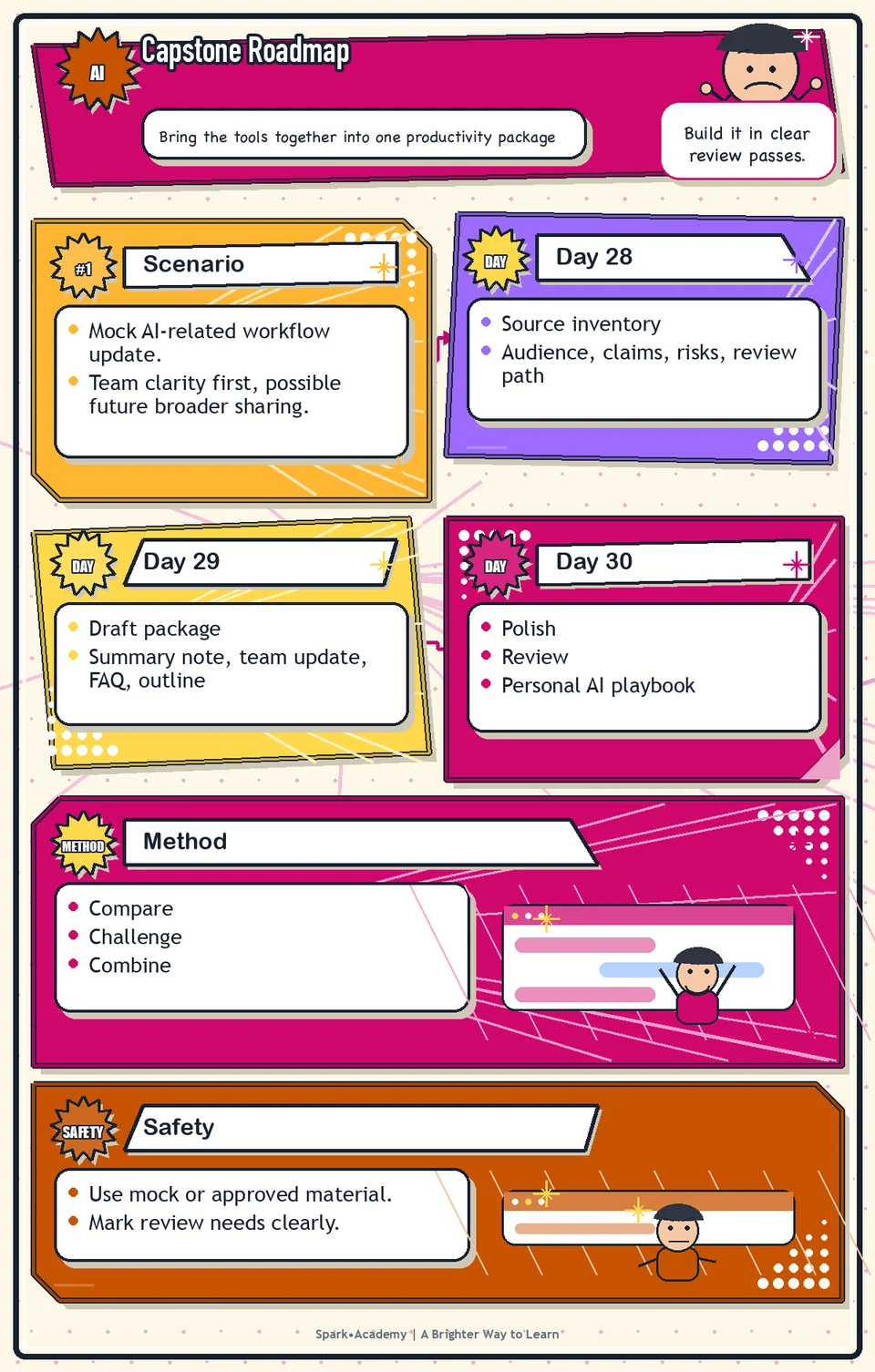
Bring everything together into one AI-assisted productivity package.
The final three days bring everything together. Instead of doing separate exercises, you will build one larger project in three small steps. The scenario is: a safe or mock workplace is preparing to communicate an AI-related workflow update to teammates, with possible future broader sharing.
You will also practice Compare, Challenge, Combine: compare what different tools produce, challenge one tool's answer with another, and combine the best parts using your own judgment.
Use mock, public, sanitized, or approved source material for the capstone. The point is to practice the workflow, not to create real public-facing messaging without review.
Why It Matters
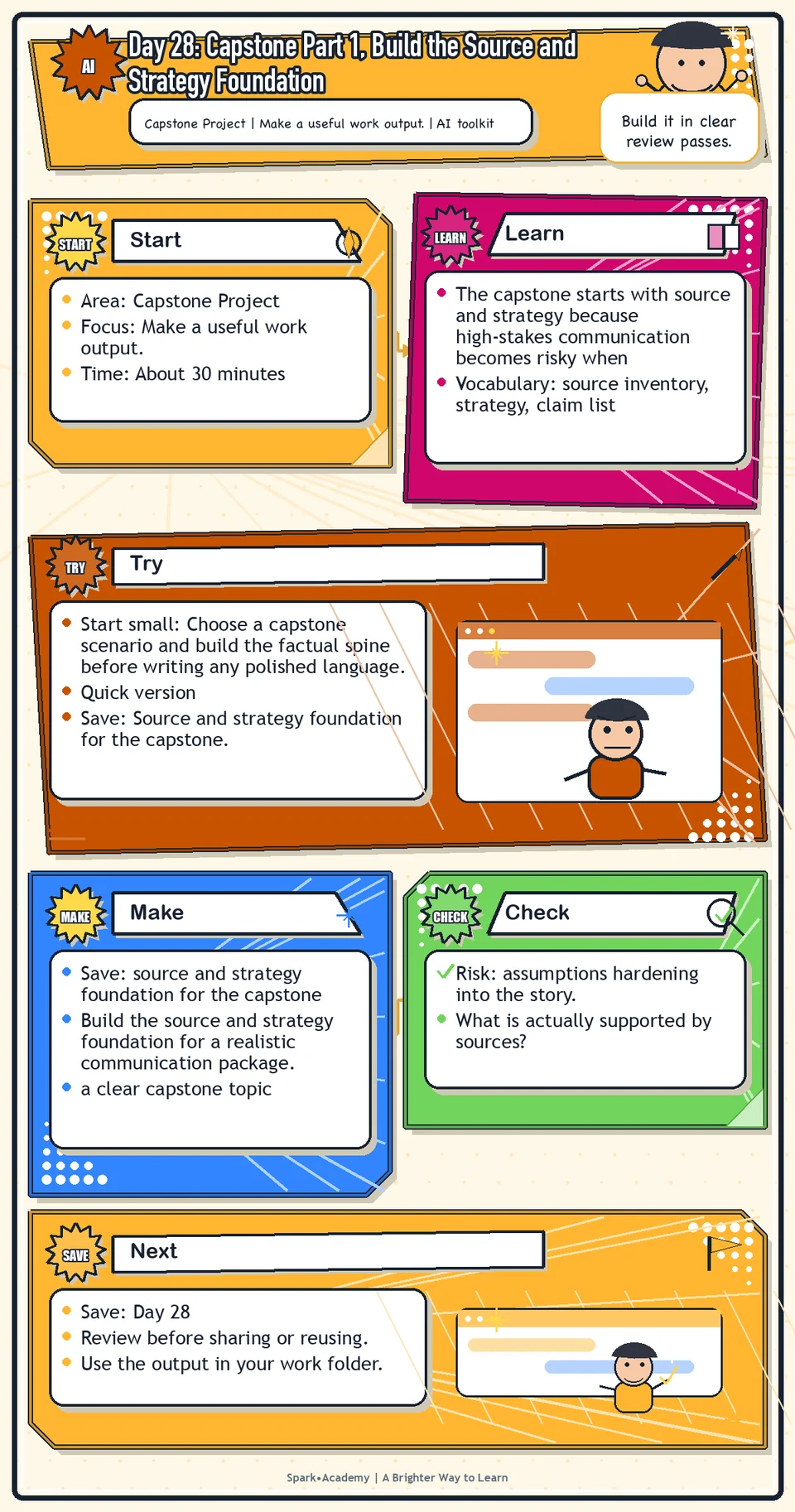
The capstone starts with source and strategy because high-stakes communication becomes risky when assumptions harden into story too quickly. Slow down the setup so the final package can move faster and withstand review.
Build one factual spine before drafting: audience, purpose, message strategy, evidence, safe claims, open questions, risks, dependencies, approvals, and unresolved decisions.
Save the foundation before creating final assets. It should keep the capstone from becoming polished but unsupported.
Choose one scenario track before you draft:
- Internal rollout: A team is piloting an AI-assisted workflow and needs an internal update, FAQ, and review note.
- Customer-facing FAQ: A product or service change may eventually need public explanation, but today you will build a safe mock FAQ with review flags.
- Technical feature explanation: A technical capability needs to be translated into plain English for nontechnical stakeholders, with limits and engineering questions attached.
Stay with the same track across Days 28 to 30 so the final package feels coherent instead of scattered.
Know Before You Try
Good workplace communication starts before writing. The capstone begins by building a source and strategy foundation so the story does not move faster than the facts.
The foundation answers: What are we communicating? Who is it for? What outcome do we want? What sources support it? What claims are safe? What is unknown? What could be misunderstood? Who needs to review it?
The foundation should separate facts, interpretations, assumptions, open questions, and recommendations. If those categories blur together, the final assets may sound confident while resting on unclear support.
Use the tools in combination, with each tool doing a clear job. Gemini Notebook can support source-grounded summary. ChatGPT can shape strategy and questions. Gemini can support Workspace or web structure. ChatGPT Work can support technical translation if needed.
The point is a single factual spine for the capstone. Before producing assets, make sure the foundation names the audience, message, evidence, risks, review needs, and unresolved decisions.
Before you try
- The capstone foundation should include a source inventory, stakeholder map, audience definition, claim inventory, review path, and decision about what is mock versus approved.
- Start with truth before story. If the sources are weak, unclear, or not approved, the draft should stay limited and clearly labeled.
- Use Compare, Challenge, Combine deliberately: compare tool outputs, challenge unsupported claims, and combine only what survives your review.
Where this helps
Use this at the beginning of any important rollout, announcement, media response, decision briefing, or workplace project.
- before building a rollout package, briefing, FAQ, team update, or web outline
- a project has source material, claims, audience needs, and review requirements
- you need to compare tool outputs before choosing a direction
Try It
Start small: Choose a capstone scenario and build the factual spine before writing any polished language.
Quick version
- Save: Source and strategy foundation for the capstone.
- Minimum useful version: Choose one capstone topic and fill in audience, purpose, three supported facts, three open questions, and review needs.
- If stuck: Pick one manageable scenario: product update, team update, AI feature update, media inquiry, or decision-support topic.
- Done when: You know what is supported, what is assumed, and what must be reviewed before drafting.
- Add only if useful: Add a claim inventory with safe claims, risky claims, and claims to avoid.
Aim for
- Topic: AI-supported customer support update.
- Supported fact: "The source says the workflow is being reviewed by the support team."
- Assumption: "This may improve response clarity, but that outcome is not proven yet."
- Review need: Product, legal/privacy, customer-facing language, and technical accuracy.
Practice
Choose one scenario:
- Product update.
- AI feature or workflow change.
- Team update.
- Media inquiry.
- Decision-support topic.
Use Gemini Notebook to create a source-based briefing. Use ChatGPT to identify:
- Audience.
- Main message.
- Proof points.
- Risks.
- Open questions.
- Review needs.
Use ChatGPT Work or ChatGPT for technical translation if needed. Then ask ChatGPT to compare what each tool did well, what is missing, and what needs human review.
Work in passes:
- Choose a safe capstone topic.
- Collect or create safe source material.
- Use Gemini Notebook or ChatGPT to summarize what the sources support.
- Create a strategy note with audience, goal, key points, risks, questions, and review needs.
If the project feels too large, narrow it to one deliverable, such as a mock team update with an FAQ. A smaller capstone done carefully is better than a sprawling one.
Before you save it:
- Create a source table with columns for source, owner, date, approved use, key facts, and review notes.
- Before moving to drafting, identify the three claims most likely to need review.
Prompt
Primary Prompt
Use this to get a first useful draft.
Help me build the source and strategy foundation for a safe or mock capstone scenario. Separate audience, main message, proof points, risks, open questions, review needs, technical translation needs, and what each AI tool did well or missed.Role:
Act as a capstone strategy coach.
Task:
Help me build the source and strategy foundation for a safe or mock capstone scenario. Separate audience, main message, proof points, risks, open questions, review needs, technical translation needs, and what each AI tool did well or missed.
Context:
- Keep in mind: A strong source and strategy foundation comes before drafting so the final package stays grounded in sources, claims, risks, and review needs.
- Work context: capstone source and strategy foundation.
- Save as: source and strategy foundation.
Use these details if I provide them:
- Safe capstone topic.
- Source inventory.
- Audience.
- Goal.
- Risks and review needs.
Ask first only if needed:
- Ask up to three clarifying questions only when missing details would materially change the answer. Otherwise, proceed with clearly labeled assumptions or placeholders.
Keep it safe:
- Use only mock, public, sanitized, or workplace-approved information. Do not include sensitive, confidential, personal, customer, legal, financial, unreleased, private-code, credential, or regulated material unless that use is explicitly approved.
- Do not invent names, dates, metrics, source content, evidence, approvals, or promises. If details are missing, use labeled placeholders or a brief mock example.
How to work:
- Build the foundation before drafting.
- Separate audience, message, proof, risks, questions, review needs, technical needs, and tool comparison.
- Keep truth before story.
Give me:
1. Safe scope and assumptions
2. Audience and main message
3. Source and claim inventory
4. Proof points, risks, and open questions
5. Review and technical translation needs
6. Notes on what each AI tool did well
7. Reusable foundation-building prompt pattern
Style:
- Practical, clear, friendly, plain-English, specific, and non-hype.
- Use headings, bullets, or a compact table when that makes the output easier to scan.
Before you finish:
- The foundation should make unsupported drafting harder.
- Make sure the answer is usable, grounded in provided or clearly labeled mock information, and clear about what needs human review before real use.Improve Prompt
Use this to strengthen the foundation before drafting.
Review my capstone source and strategy foundation. Separate supported facts, assumptions, open questions, weak sources, risky claims, missing stakeholders, and review needs. Tell me what should be fixed before drafting any productivity package.Role:
Act as a source-and-strategy reviewer who checks supported facts, assumptions, risky claims, stakeholders, and review needs.
Task:
Review my capstone source and strategy foundation. Separate supported facts, assumptions, open questions, weak sources, risky claims, missing stakeholders, and review needs. Tell me what should be fixed before drafting any productivity package.
Context:
- Keep in mind: A strong source and strategy foundation comes before drafting so the final package stays grounded in sources, claims, risks, and review needs.
- Work context: capstone source and strategy foundation.
- Save as: source and strategy foundation.
Use these details if I provide them:
- Safe capstone topic.
- Source inventory.
- Audience.
- Goal.
- Risks and review needs.
Ask first only if needed:
- Ask up to three clarifying questions only when missing details would materially change the answer. Otherwise, proceed with clearly labeled assumptions or placeholders.
Keep it safe:
- Use only mock, public, sanitized, or workplace-approved information. Do not include sensitive, confidential, personal, customer, legal, financial, unreleased, private-code, credential, or regulated material unless that use is explicitly approved.
- Do not invent names, dates, metrics, source content, evidence, approvals, or promises. If details are missing, use labeled placeholders or a brief mock example.
How to work:
- Review the foundation for unsupported facts, assumptions, weak sources, risky claims, missing stakeholders, and review gaps.
- Identify what must be fixed before drafting.
- Prioritize the fixes.
Give me:
1. Quick verdict
2. Issue table with priority, evidence, and recommended fix
3. Revised draft or targeted rewrite
4. Questions or approvals still needed
5. Before-use review checklist
6. Reusable review prompt pattern
Style:
- Practical, clear, friendly, plain-English, specific, and non-hype.
- Use headings, bullets, or a compact table when that makes the output easier to scan.
Before you finish:
- The foundation should make unsupported drafting harder.
- Make sure the answer is usable, grounded in provided or clearly labeled mock information, and clear about what needs human review before real use.Apply Prompt
Use this to narrow the capstone scope.
Ask me for my safe capstone topic, source material, audience, and intended output. Then help me narrow the project to a manageable foundation with source inventory, claim inventory, risks, questions, and review path.Role:
Act as a practical capstone-scope coach who helps me narrow a safe topic into a source and strategy foundation.
Task:
Ask me for my safe capstone topic, source material, audience, and intended output. Then help me narrow the project to a manageable foundation with source inventory, claim inventory, risks, questions, and review path.
Context:
- Keep in mind: A strong source and strategy foundation comes before drafting so the final package stays grounded in sources, claims, risks, and review needs.
- Work context: capstone source and strategy foundation.
- Save as: source and strategy foundation.
Use these details if I provide them:
- Safe capstone topic.
- Source inventory.
- Audience.
- Goal.
- Risks and review needs.
Ask first only if needed:
- Ask up to three clarifying questions only when missing details would materially change the answer. Otherwise, proceed with clearly labeled assumptions or placeholders.
Keep it safe:
- Use only mock, public, sanitized, or workplace-approved information. Do not include sensitive, confidential, personal, customer, legal, financial, unreleased, private-code, credential, or regulated material unless that use is explicitly approved.
- Do not invent names, dates, metrics, source content, evidence, approvals, or promises. If details are missing, use labeled placeholders or a brief mock example.
How to work:
- Ask for topic, sources, audience, and intended output.
- Narrow the project to a manageable foundation.
- Create source and claim inventories.
Give me:
1. Questions to ask me first
2. Safe assumptions if I do not answer yet
3. Adapted source and strategy foundation
4. Review before real use
5. Reusable prompt pattern
Style:
- Practical, clear, friendly, plain-English, specific, and non-hype.
- Use headings, bullets, or a compact table when that makes the output easier to scan.
Before you finish:
- The foundation should make unsupported drafting harder.
- Make sure the answer is usable, grounded in provided or clearly labeled mock information, and clear about what needs human review before real use.Make Something Useful
Build the source and strategy foundation for a realistic communication package.
Save source and strategy foundation for the capstone.
Make sure it includes:
- a clear capstone topic
- a safe source list
- source-supported takeaways
- audience and goal definition
- risks, open questions, and review needs
Review and Save
Specific risk to check: The risk today is assumptions hardening into the story. Keep sources, facts, interpretations, and open questions separate before drafting anything polished.
Keep source-based facts separate from interpretation. Mark all claims that need subject-matter, legal, privacy, compliance, or other appropriate review.
Ask yourself:
- What is actually supported by sources?
- What is still an assumption?
- What would different stakeholders worry about?
- What must get human review before this could be real?
Watch for
A strategy built from incomplete sources can be misleading. If the source material is weak, the foundation is weak.
Do not start writing the story before gathering the truth. AI can make an incomplete foundation sound finished, which is exactly why this step matters.
Save
Save this in your 30-day work folder as Day 28 - source and strategy foundation for the capstone.
Add a quick reuse note: Use this at work for: grounding an announcement, rollout, briefing, or capstone project in sources before drafting.
Save the foundation as Day 28. You will need it for Days 29 and 30.
Check yourself
- I chose one realistic capstone scenario.
- I used Gemini Notebook to create a source-based summary.
- I used ChatGPT to create a work plan note.
- I used ChatGPT Work or ChatGPT to translate technical material if needed.
- I compared what each tool did well.
- I marked what needs relevant subject-matter, legal, privacy, or compliance review.
- I can explain the capstone topic, source support, audience, risks, and review needs before drafting.
- I can build a source and strategy foundation before drafting a higher-stakes communication package.