Day 16: Produce a Source Based Notebook Summary
What you will learn and leave with
This lesson teaches you how to produce a source based notebook summary. It uses Gemini Notebook as a practical learning context while keeping privacy, accuracy, context, and human judgment in charge.
Use this when: you want to create a practical, reviewable work output with Gemini Notebook. By the end: you will save source-based notebook summary.
Course position: Day 16 of 30 · Gemini Notebook module
Continue: Day 17: Use Gemini Notebook for Learning Aids
Source check: product features and interfaces can change. Gemini Notebook Help Center was checked for this course on 2026-08-30; confirm current details before using a changing feature.
Listen to the Day 16 Introduction
This short audio introduces the day and what to focus on.
Day 16: Produce a Source Based Notebook Summary audio transcript
A summary is only useful if it helps you understand the source without drifting away from it.
That sounds simple, but it is easy to miss.
Welcome to Day 16 of the 30-Day AI at Work Challenge: Produce a Source Based Notebook Summary.
Today, you will use Gemini Notebook to create a summary grounded in selected material. The goal is not just a shorter version of the source. The goal is a usable summary that separates what the source says from what you still need to check.
Let's start with the key distinction. A fact is something the source supports. An implication is what that fact may mean. An open question is something the source does not answer yet.
Keeping those categories separate protects your accuracy.
Gemini Notebook can help pull out main points, details, terminology, and citations. But you still need to review the result. If a sentence matters, you should be able to point back to where it came from.
The risk today is blending source facts with your interpretation. That is how a careful summary can slowly turn into a confident claim.
In the lesson, you will summarize one trusted source or notebook, then mark facts, implications, unanswered questions, and review needs. You will also notice what the summary leaves out.
Before you start, think about a source you have read recently. Did you need a quick summary, or did you need a summary that helped you make a decision?
By the end, you will save a source-based notebook summary. It should make the material easier to use while keeping uncertainty visible.
Why It Matters
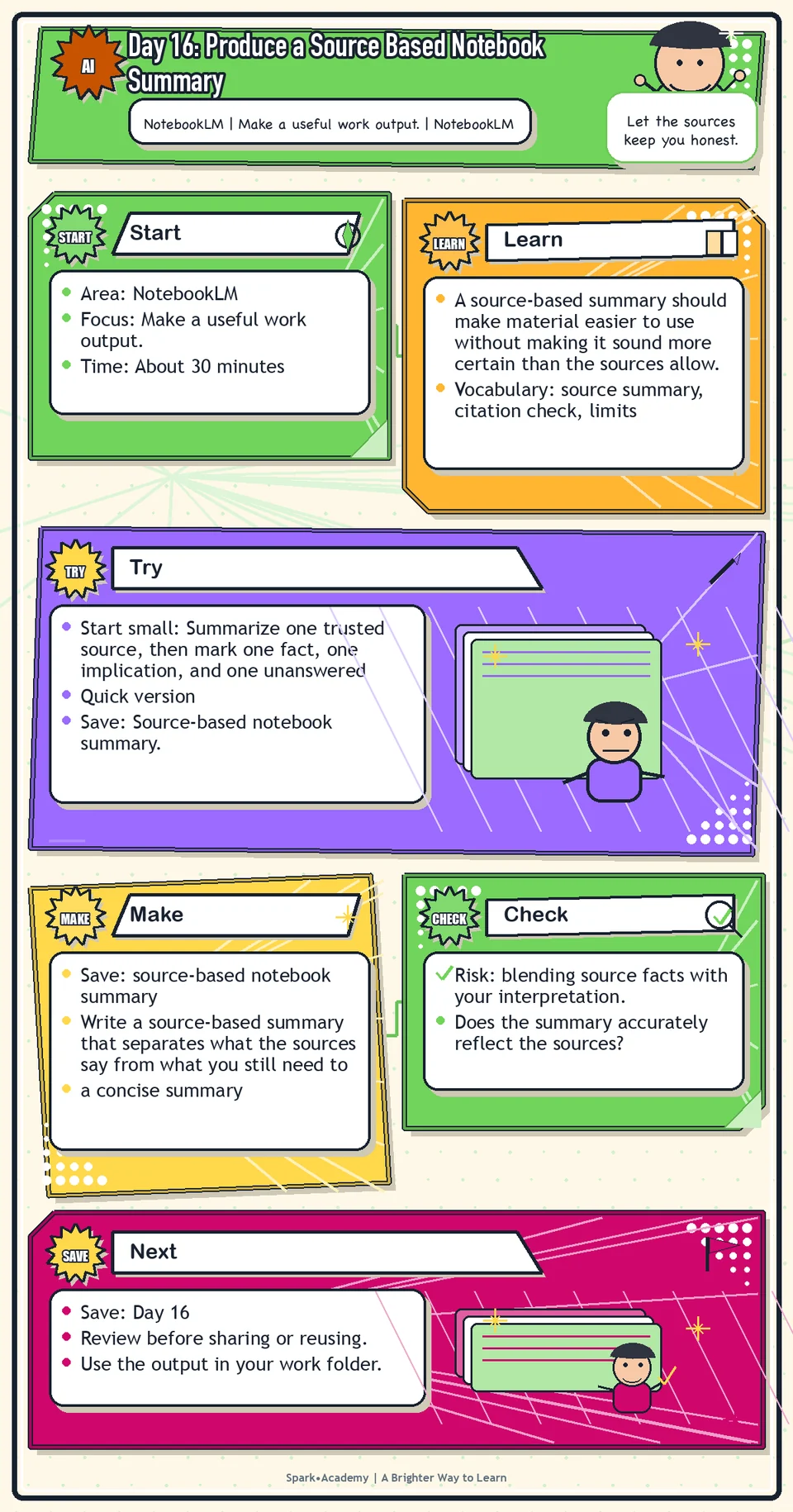
A source-based summary should make material easier to use without making it sound more certain than the sources allow. The work is compression with fidelity: keep what matters, preserve meaning, and name limits.
A good summary creates orientation quickly. A weak one creates confidence without understanding, especially if it drops caveats or imports ideas the source did not support.
Save a summary that captures key takeaways, evidence, source boundaries, and remaining uncertainties. It should preserve the meaning and implications someone would need before using the material.
Know Before You Try
A source-based summary is not just a shorter document. It is a structured account of what matters, what is supported, what is unclear, and why the information matters to the work.
A strong summary has four parts: takeaways, evidence, boundaries, and relevance. Takeaways explain the main points. Evidence shows what supports them. Boundaries name what the source does not answer. Relevance explains why it matters.
For workplace communication, the summary should also surface what might affect messaging, stakeholders, timing, risk, or review.
A good summary respects proportion. It should not give equal weight to every detail. It should highlight the ideas that affect decisions, communication, stakeholder expectations, timing, or next steps.
Use AI to create a first structure, then check it against the source. Look for missing caveats, unsupported interpretation, misplaced emphasis, and questions that should be brought to a human reviewer.
Before you try
- A source-based summary should separate what the source says from what you infer. That distinction protects accuracy and makes review easier.
- Use citations as a navigation tool. If a sentence matters, you should be able to point to where it came from.
- A strong summary includes the main points, useful details, source limitations, and questions that remain unresolved.
Where this helps
Use this when reviewing work documents, source materials, research reports, strategy notes, or workplace context documents.
- reading background material before a meeting
- preparing a briefing note from trusted documents
- you need to explain a topic without drifting away from the source
Try It
Start small: Summarize one trusted source, then mark one fact, one implication, and one unanswered question.
Quick version
- Save: Source-based notebook summary.
- Minimum useful version: Summarize one source in five points, then add one evidence note, one open question, and one thing you checked manually.
- If stuck: Use a table with four columns: takeaway, source support, confidence, and gap.
- Done when: You can show what the source supports and what it does not answer.
- Add only if useful: Add a short note explaining why one detail was left out.
Aim for
- Takeaway: The source explains how the support workflow is organized.
- Evidence: Section heading or quoted source location supports the takeaway.
- Gap: The source does not prove customer outcomes or timing.
- Manual check: "I reread the source section before saving this point."
Practice
Choose one source in your notebook. Ask Gemini Notebook to:
- Summarize the source in five points.
- Identify the most important open questions.
- Explain what would matter most for the work.
- Pull out any terms, claims, or facts that may need verification.
- Suggest what kind of human review might be needed before using the information in a public-facing context.
Create a final note with key takeaways, open questions, and work implications.
Work in passes:
- Ask Gemini Notebook for a short summary of the selected sources.
- Ask for the top takeaways and supporting details.
- Ask what the sources do not answer.
- Review at least one important source passage yourself.
If the summary is too long, ask for five bullet points. If it is too shallow, ask for takeaways with supporting details and source references.
Before you save it:
- Ask for a summary with citations, then manually check the most important citations.
- Add a short 'limits of this summary' note before saving it to the work folder.
Prompt
Primary Prompt
Use this to get a first useful draft.
Using only the sources in this notebook, summarize one source in five points, identify open questions, explain what matters to the work, flag terms or claims needing verification, and suggest review needs.Role:
Act as a source-faithful summarizer.
Task:
Using only the sources in this notebook, summarize one source in five points, identify open questions, explain what matters to the work, flag terms or claims needing verification, and suggest review needs.
Context:
- Keep in mind: A source-based summary should separate what the source says from what remains unclear, what matters to the work, and what needs review.
- Work context: source-based notebook summary.
- Save as: source-based notebook summary.
Use these details if I provide them:
- One notebook source.
- Work purpose.
- Important terms or claims.
Ask first only if needed:
- Ask up to three clarifying questions only when missing details would materially change the answer. Otherwise, proceed with clearly labeled assumptions or placeholders.
Keep it safe:
- Use only mock, public, sanitized, or workplace-approved information. Do not include sensitive, confidential, personal, customer, legal, financial, unreleased, private-code, credential, or regulated material unless that use is explicitly approved.
- Do not invent names, dates, metrics, source content, evidence, approvals, or promises. If details are missing, use labeled placeholders or a brief mock example.
How to work:
- Summarize one source in five points.
- Explain what matters to the work.
- Identify open questions and claims to verify.
Give me:
1. Five-point source summary
2. Why the source matters for the work
3. Open questions
4. Terms or claims to verify
5. Review needs
6. Reusable source-summary prompt pattern
Style:
- Practical, clear, friendly, plain-English, specific, and non-hype.
- Use headings, bullets, or a compact table when that makes the output easier to scan.
Before you finish:
- The summary should stay close enough to the source that I can check it.
- Make sure the answer is usable, grounded in provided or clearly labeled mock information, and clear about what needs human review before real use.Improve Prompt
Use this to check source fidelity.
Audit this notebook summary against the source. Separate direct source-supported points from interpretation, assumptions, and missing context. List citations or source locations I should verify before using the summary.Role:
Act as a source-summary reviewer who separates source-supported points from interpretation and assumptions.
Task:
Audit this notebook summary against the source. Separate direct source-supported points from interpretation, assumptions, and missing context. List citations or source locations I should verify before using the summary.
Context:
- Keep in mind: A source-based summary should separate what the source says from what remains unclear, what matters to the work, and what needs review.
- Work context: source-based notebook summary.
- Save as: source-based notebook summary.
Use these details if I provide them:
- One notebook source.
- Work purpose.
- Important terms or claims.
Ask first only if needed:
- Ask up to three clarifying questions only when missing details would materially change the answer. Otherwise, proceed with clearly labeled assumptions or placeholders.
Keep it safe:
- Use only mock, public, sanitized, or workplace-approved information. Do not include sensitive, confidential, personal, customer, legal, financial, unreleased, private-code, credential, or regulated material unless that use is explicitly approved.
- Do not invent names, dates, metrics, source content, evidence, approvals, or promises. If details are missing, use labeled placeholders or a brief mock example.
How to work:
- Audit the summary against the source.
- Separate source-supported facts from interpretation and assumptions.
- Name citations or locations to check.
Give me:
1. Quick verdict
2. Issue table with priority, evidence, and recommended fix
3. Revised draft or targeted rewrite
4. Questions or approvals still needed
5. Before-use review checklist
6. Reusable review prompt pattern
Style:
- Practical, clear, friendly, plain-English, specific, and non-hype.
- Use headings, bullets, or a compact table when that makes the output easier to scan.
Before you finish:
- The summary should stay close enough to the source that I can check it.
- Make sure the answer is usable, grounded in provided or clearly labeled mock information, and clear about what needs human review before real use.Apply Prompt
Use this to make the summary useful for work.
Using only this notebook source, create a work-ready summary with key facts, why they matter, open questions, terms to define, claims to verify, and next actions for a teammate who has not read the source.Role:
Act as a practical source-summary coach who helps me create a work-ready summary from approved source material.
Task:
Using only this notebook source, create a work-ready summary with key facts, why they matter, open questions, terms to define, claims to verify, and next actions for a teammate who has not read the source.
Context:
- Keep in mind: A source-based summary should separate what the source says from what remains unclear, what matters to the work, and what needs review.
- Work context: source-based notebook summary.
- Save as: source-based notebook summary.
Use these details if I provide them:
- One notebook source.
- Work purpose.
- Important terms or claims.
Ask first only if needed:
- Ask up to three clarifying questions only when missing details would materially change the answer. Otherwise, proceed with clearly labeled assumptions or placeholders.
Keep it safe:
- Use only mock, public, sanitized, or workplace-approved information. Do not include sensitive, confidential, personal, customer, legal, financial, unreleased, private-code, credential, or regulated material unless that use is explicitly approved.
- Do not invent names, dates, metrics, source content, evidence, approvals, or promises. If details are missing, use labeled placeholders or a brief mock example.
How to work:
- Create a work-ready summary for a teammate.
- Include key facts, why they matter, open questions, terms, claims to verify, and next actions.
- Stay inside source boundaries.
Give me:
1. Five-point summary
2. Why it matters
3. Open questions
4. Terms or claims to verify
5. Review needs
Style:
- Practical, clear, friendly, plain-English, specific, and non-hype.
- Use headings, bullets, or a compact table when that makes the output easier to scan.
Before you finish:
- The summary should stay close enough to the source that I can check it.
- Make sure the answer is usable, grounded in provided or clearly labeled mock information, and clear about what needs human review before real use.Make Something Useful
Write a source-based summary that separates what the sources say from what you still need to check.
Save source-based notebook summary.
Make sure it includes:
- a concise summary
- key takeaways tied to source material
- important unknowns or gaps
- notes about what you checked manually
Review and Save
Specific risk to check: The risk today is blending source facts with your interpretation. Keep what the source says separate from what you infer, recommend, or still need to verify.
Check whether the summary accurately reflects the source. If something sounds important, trace it back to the source before using it.
Ask yourself:
- Does the summary accurately reflect the sources?
- Did it omit something important?
- Did it answer beyond the sources?
- Would I feel comfortable showing which source supports each key point?
Watch for
Summaries can hide nuance. If the material is sensitive or complex, read the original source too.
A source-based summary can still be incomplete if the source set is incomplete. Always ask whether you have the right sources, not just whether the summary sounds good.
Save
Save this in your 30-day work folder as Day 16 - source-based notebook summary.
Add a quick reuse note: Use this at work for: summarizing trusted material before a meeting, brief, decision note, FAQ, or review conversation.
Save the summary with the notebook name and source list. That context matters later.
Check yourself
- I selected one source in Gemini Notebook.
- I created a five point summary.
- I identified open questions.
- I identified work implications.
- I checked whether the summary stayed close to the source.
- I saved the summary in a useful format.
- I can name what the sources support and what they do not answer.
- I can summarize source material while naming evidence, gaps, and what still needs checking.