Day 11: Produce a Safer, Clearer Message
What you will learn and leave with
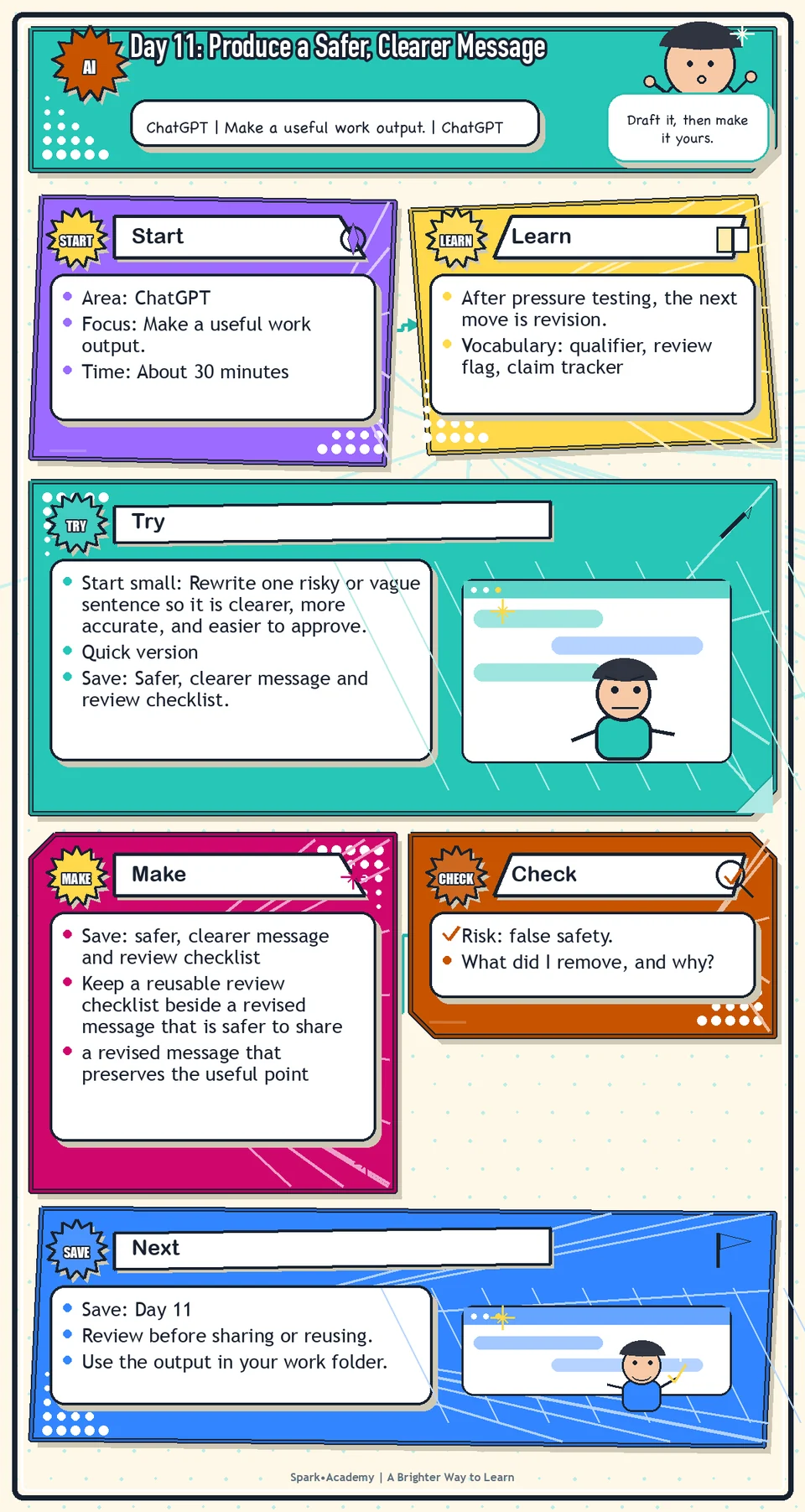
This lesson teaches you how to produce a safer, clearer message. It uses ChatGPT as a practical learning context while keeping privacy, accuracy, context, and human judgment in charge.
Use this when: you want to create a practical, reviewable work output with ChatGPT. By the end: you will save safer, clearer message and review checklist.
Course position: Day 11 of 30 · ChatGPT module
Continue: Day 12: Use ChatGPT for Documents, Data, Visuals, Tools, and Integrations
Source check: product features and interfaces can change. OpenAI ChatGPT Help Center was checked for this course on 2026-08-30; confirm current details before using a changing feature.
Listen to the Day 11 Introduction
This short audio introduces the day and what to focus on.
Day 11: Produce a Safer, Clearer Message audio transcript
Safer writing does not have to mean vague writing.
In fact, the best safer message is usually clearer, because it says exactly what can be supported and exactly what still needs review.
Welcome to Day 11 of the 30-Day AI at Work Challenge: Produce a Safer, Clearer Message.
Yesterday, you practiced pressure testing. Today, you take the next step: revision.
The job is to decide which claims to keep, soften, remove, support, or route for review. That decision depends on the audience, the evidence, the risk, and the purpose of the message.
Here is the main idea. A safer message is not a weaker message. It is a message whose confidence matches what you actually know.
That means cutting unsupported claims, clarifying vague wording, preserving necessary caveats, and making review needs visible. It also means avoiding false safety. If you make a message so cautious that no one understands the point, it is not useful.
In today's lesson, you will revise a message and create a review checklist. You will look for unsupported claims, risky wording, vague language, and places where the reader might misunderstand what is approved or proven.
Pay attention to qualifiers. Words like may, can, designed to, draft, or under review can help when they are accurate. But they should not be used to blur uncertainty.
Before you start, think of a message that needed to be both clear and careful. What made it hard?
By the end, you will save a safer, clearer message and a review checklist. The goal is a draft that someone can trust enough to review seriously.
Why It Matters
After pressure testing, the next move is revision. Decide which claims to keep, soften, remove, support, or route for review based on audience, evidence, risk, and purpose.
A responsible message is not simply shorter or more polished. It helps the reader understand what matters while preventing avoidable confusion, overstatement, false certainty, or accidental commitments.
Save the revised message with a review checklist. The checklist should show what is supported, what could be misread, what needs confirmation, and what must be reviewed before sharing.
Know Before You Try
A safer message is not a weaker message. It is a message whose confidence matches its evidence.
The revision task is to keep the useful point while removing avoidable risk. That means cutting unsupported claims, clarifying vague language, preserving necessary specificity, and marking anything that needs human or subject-matter review.
If review removes all specificity, the message may become safe but useless. If revision keeps every bold claim, it may stay useful but risky. The skill is finding language that is accurate, supportable, and still meaningful.
Use a claim review checklist as a repeatable safety rail: What are we saying? What supports it? What could be misunderstood? What should be softened, clarified, or removed? Who needs to review it before it is shared?
The output should be more ready for review, not merely more polished. A good safer draft makes it easier for a reviewer to trust, challenge, and improve the message.
Before you try
- A safer message is not a vague message. It is a clear message that says only what the evidence, context, and approvals support.
- Use qualifiers carefully. Words like may, can, designed to, early, draft, and under review can help when they are accurate, but they should not be used to blur uncertainty.
- Create a small claim tracker when the stakes are high: claim, source, reviewer, status, and approved language.
Where this helps
Use this when drafting public-facing or sensitive workplace messages where accuracy and trust matter.
- revising messages after stakeholder feedback
- a draft includes AI, product, domain, trust, access, or outcome language
- you need to make a draft clearer without removing its main point
Try It
Start small: Rewrite one risky or vague sentence so it is clearer, more accurate, and easier to approve.
Quick version
- Save: Safer, clearer message and review checklist.
- Minimum useful version: Revise one risky sentence and make a four-row checklist: supported, unclear, needs evidence, needs review.
- If stuck: Replace "AI helps customers get answers faster" with "The team is exploring ways AI may help support teams respond more clearly, pending review."
- Done when: The message is more specific, less risky, and still useful.
- Add only if useful: Add a revision table showing original claim, risk, better wording, evidence needed, and reviewer needed.
Aim for
- Original: "AI will help customers get answers faster."
- Risk: The outcome may be unproven or too broad.
- Safer version: "The team is reviewing AI-supported ways to make support information easier to find and understand."
- Review checklist item: "Confirm customer impact, approved wording, and claims that need evidence."
Practice
Choose a prior message or use this draft: "A mock workplace helps customers get answers faster with AI-powered technology." Ask ChatGPT to review the message for:
- Clarity.
- Credibility.
- Unsupported claims.
- Possible misunderstanding.
- Stakeholder concerns.
- Review needs.
Ask for a clearer and more grounded rewrite. Then ask for a review checklist showing what relevant subject-matter, legal, privacy, or compliance should review before public-facing use.
Work in passes:
- Identify the strongest useful point in the original message.
- Mark any vague, broad, or unsupported language.
- Ask ChatGPT for a more grounded rewrite.
- Create a checklist you can reuse for future claims.
If the rewrite becomes dull, ask for a version that is warm, clear, and grounded. If it becomes too promotional, ask for a version that a skeptical reviewer would find fair.
Before you save it:
- Revise once for plain English and once for claim discipline.
- Leave visible notes for anything that needs relevant subject-matter, legal, privacy, or compliance review.
Prompt
Primary Prompt
Use this to get a first useful draft.
Review this safe or mock message for clarity, credibility, unsupported claims, possible misunderstanding, stakeholder concerns, and review needs: a safe or mock workplace helps customers get answers faster with AI-powered technology. Then create a clearer, more grounded rewrite and a review checklist.Role:
Act as a message reviewer focused on clarity and credibility.
Task:
Review this safe or mock message for clarity, credibility, unsupported claims, possible misunderstanding, stakeholder concerns, and review needs: a safe or mock workplace helps customers get answers faster with AI-powered technology. Then create a clearer, more grounded rewrite and a review checklist.
Context:
- Keep in mind: A safer message can still be specific and useful when it separates grounded claims, cautious language, stakeholder concerns, and review needs.
- Work context: safer clearer workplace communication.
- Save as: safer message and review checklist.
Use these details if I provide them:
- Mock message.
- Audience.
- Required facts.
- Words to avoid.
- Review standards.
Ask first only if needed:
- Ask up to three clarifying questions only when missing details would materially change the answer. Otherwise, proceed with clearly labeled assumptions or placeholders.
Keep it safe:
- Use only mock, public, sanitized, or workplace-approved information. Do not include sensitive, confidential, personal, customer, legal, financial, unreleased, private-code, credential, or regulated material unless that use is explicitly approved.
- Do not invent names, dates, metrics, source content, evidence, approvals, or promises. If details are missing, use labeled placeholders or a brief mock example.
How to work:
- Review clarity, credibility, unsupported claims, misunderstanding, stakeholder concerns, and review needs.
- Create a grounded rewrite.
- Build a practical review checklist.
Give me:
1. Message risk scan
2. Claim, clarity, and stakeholder concern table
3. Safer clearer rewrite
4. Review needs and open questions
5. Final message checklist
6. Reusable safe-message prompt pattern
Style:
- Practical, clear, friendly, plain-English, specific, and non-hype.
- Use headings, bullets, or a compact table when that makes the output easier to scan.
Before you finish:
- The answer should show that safer wording can also be stronger wording.
- Make sure the answer is usable, grounded in provided or clearly labeled mock information, and clear about what needs human review before real use.Improve Prompt
Use this to build the review checklist.
Turn the critique of this message into a practical review checklist. Include checks for audience, evidence, overstatement, privacy or compliance sensitivity, stakeholder concerns, missing context, and final approval needs.Role:
Act as a safer-message reviewer who checks clarity, credibility, evidence, stakeholder concerns, and approvals.
Task:
Turn the critique of this message into a practical review checklist. Include checks for audience, evidence, overstatement, privacy or compliance sensitivity, stakeholder concerns, missing context, and final approval needs.
Context:
- Keep in mind: A safer message can still be specific and useful when it separates grounded claims, cautious language, stakeholder concerns, and review needs.
- Work context: safer clearer workplace communication.
- Save as: safer message and review checklist.
Use these details if I provide them:
- Mock message.
- Audience.
- Required facts.
- Words to avoid.
- Review standards.
Ask first only if needed:
- Ask up to three clarifying questions only when missing details would materially change the answer. Otherwise, proceed with clearly labeled assumptions or placeholders.
Keep it safe:
- Use only mock, public, sanitized, or workplace-approved information. Do not include sensitive, confidential, personal, customer, legal, financial, unreleased, private-code, credential, or regulated material unless that use is explicitly approved.
- Do not invent names, dates, metrics, source content, evidence, approvals, or promises. If details are missing, use labeled placeholders or a brief mock example.
How to work:
- Turn critique into a reusable checklist.
- Cover audience, evidence, overstatement, privacy or compliance sensitivity, and approvals.
- Make the checklist easy to reuse.
Give me:
1. Quick verdict
2. Issue table with priority, evidence, and recommended fix
3. Revised draft or targeted rewrite
4. Questions or approvals still needed
5. Before-use review checklist
6. Reusable review prompt pattern
Style:
- Practical, clear, friendly, plain-English, specific, and non-hype.
- Use headings, bullets, or a compact table when that makes the output easier to scan.
Before you finish:
- The answer should show that safer wording can also be stronger wording.
- Make sure the answer is usable, grounded in provided or clearly labeled mock information, and clear about what needs human review before real use.Apply Prompt
Use this to revise a message with boundaries.
Ask me for a safe, approved, or mock message, target reader, required facts, and words to avoid. Then create a safer rewrite and explain which edits improved clarity, credibility, and review readiness.Role:
Act as a practical message-safety coach who helps me revise a safe message without losing usefulness.
Task:
Ask me for a safe, approved, or mock message, target reader, required facts, and words to avoid. Then create a safer rewrite and explain which edits improved clarity, credibility, and review readiness.
Context:
- Keep in mind: A safer message can still be specific and useful when it separates grounded claims, cautious language, stakeholder concerns, and review needs.
- Work context: safer clearer workplace communication.
- Save as: safer message and review checklist.
Use these details if I provide them:
- Mock message.
- Audience.
- Required facts.
- Words to avoid.
- Review standards.
Ask first only if needed:
- Ask up to three clarifying questions only when missing details would materially change the answer. Otherwise, proceed with clearly labeled assumptions or placeholders.
Keep it safe:
- Use only mock, public, sanitized, or workplace-approved information. Do not include sensitive, confidential, personal, customer, legal, financial, unreleased, private-code, credential, or regulated material unless that use is explicitly approved.
- Do not invent names, dates, metrics, source content, evidence, approvals, or promises. If details are missing, use labeled placeholders or a brief mock example.
How to work:
- Ask for message, reader, required facts, and words to avoid.
- Create a safer rewrite.
- Explain which edits improved clarity and credibility.
Give me:
1. Questions to ask me first
2. Safe assumptions if I do not answer yet
3. Adapted safer message and review checklist
4. Review before real use
5. Reusable prompt pattern
Style:
- Practical, clear, friendly, plain-English, specific, and non-hype.
- Use headings, bullets, or a compact table when that makes the output easier to scan.
Before you finish:
- The answer should show that safer wording can also be stronger wording.
- Make sure the answer is usable, grounded in provided or clearly labeled mock information, and clear about what needs human review before real use.Make Something Useful
Keep a reusable review checklist beside a revised message that is safer to share for feedback.
Save safer, clearer message and review checklist.
Make sure it includes:
- a revised message that preserves the useful point
- a list of claims that need evidence
- a checklist for reviewing future messages
- clear notes about human review needs
Review and Save
Specific risk to check: The risk today is false safety: making a message vague enough to avoid risk but too unclear to help the reader. Safer should still mean useful.
Confirm the rewrite preserves meaning without inventing proof. Make sure every claim can be traced to a source or stakeholder approval.
Ask yourself:
- What did I remove, and why?
- What did I keep, and what supports it?
- Could this be misunderstood by customers, subject-matter experts, reporters, or workplace partners?
- Does the message still do its job after becoming more careful?
Watch for
Safer language should not become meaningless language. If the message becomes too vague, go back and add specific, supportable details.
Do not confuse careful with vague. A careful message should usually be more specific, not less specific. Replace broad claims with clearer, supported language whenever possible.
Save
Save this in your 30-day work folder as Day 11 - safer, clearer message and review checklist.
Add a quick reuse note: Use this at work for: revising a sensitive message so it stays clear, useful, accurate, and review-ready.
Save the checklist in your prompt library or work folder. It can become one of your most useful reusable assets.
Check yourself
- I selected or created a message to revise.
- I reviewed the message for clarity and credibility.
- I identified unsupported or risky claims.
- I rewrote the message in a safer and clearer way.
- I created a review checklist.
- I understand how to make language more grounded without making it meaningless.
- I can use my checklist to review a future message before asking others for feedback.
- I can revise a sensitive message so it is safer, clearer, and easier for the right reviewer to assess.