Day 27: Produce Technical Questions
What you will learn and leave with
This lesson teaches you how to produce technical questions. It uses ChatGPT Work as a practical learning context while keeping privacy, accuracy, context, and human judgment in charge.
Use this when: you want to create a practical, reviewable work output with ChatGPT Work. By the end: you will save technical question bank.
Course position: Day 27 of 30 · ChatGPT Work module
Continue: Day 28: Capstone Part 1, Build the Source and Strategy Foundation
Source check: product features and interfaces can change. ChatGPT Work documentation was checked for this course on 2026-08-30; confirm current details before using a changing feature.
Listen to the Day 27 Introduction
This short audio introduces the day and what to focus on.
Day 27: Produce Technical Questions audio transcript
You do not always need the full technical answer before a meeting.
Sometimes what you need is a better question.
Welcome to Day 27 of the 30-Day AI at Work Challenge: Produce Technical Questions.
Today, you will build a technical question bank. The goal is to prepare for product, engineering, implementation, or technical review conversations with more clarity and less guesswork.
Let's start with the main idea. Good technical questions are specific, answerable, and connected to a decision or communication need.
A vague question like, "Is this okay?" does not help much. A stronger question asks what is true, what is tested, what is approved, what depends on something else, what cannot be claimed yet, or what would change for users.
ChatGPT Work or ChatGPT can help you understand enough context to ask those questions. But the questions still need your judgment. They should be respectful of the technical partner's expertise and clear about why the answer matters.
The risk today is vague questioning. If a question is too broad, too abstract, or disconnected from a real decision, it may create more conversation without moving the work forward.
In the lesson, you will create a short technical briefing and a question bank. You will group questions by topic and mark the must-ask questions before communicating broadly or externally.
Before you begin, think of a technical topic you might need to explain. What would you need to confirm before you could write about it responsibly?
By the end, you will save a technical question bank. The value is not pretending to know everything. It is walking into the conversation ready to learn the right things.
Why It Matters
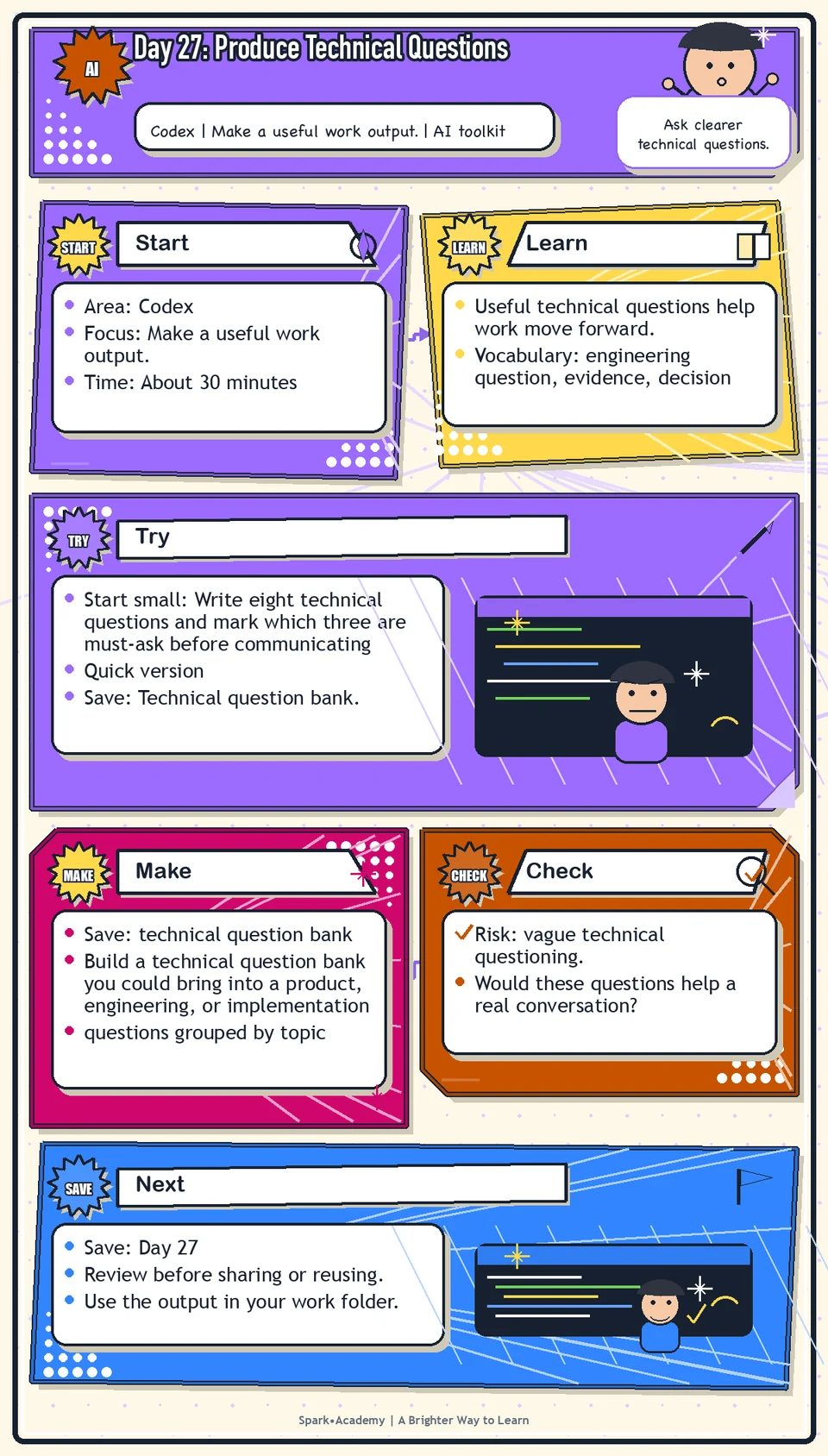
Useful technical questions help work move forward. They ask about definitions, status, evidence, limits, dependencies, risks, timelines, and review needs in a way technical partners can answer.
You do not always need to master the full technical answer before contributing. In many meetings, the highest-value contribution is a question that reveals an assumption, prevents overclaiming, or uncovers what must be checked before communicating.
Save a question bank tied to a communication decision. The questions should be specific, answerable, and useful before anyone drafts high-stakes language.
Know Before You Try
You do not need to know every technical detail to ask good questions. You need enough understanding to identify what matters, what is unclear, and what could affect communication.
Good questions are specific, answerable, and respectful of the partner's expertise. They help clarify what is true, what is tested, what is approved, what is still uncertain, and what should not be said.
Use a question ladder: definition, status, evidence, limits, impact, risk, timeline, and review. Moving up the ladder turns general confusion into specific questions.
Instead of asking, "How does this work?" you might ask, "What part of this feature is new, what evidence supports the claim, and what should we avoid saying publicly?"
Sorting questions by urgency makes them easier to use. Some questions must be answered before writing, some are helpful for context, and some can wait until later.
Good technical questions also build trust. They show that you are not asking a technical partner to approve vague language; you are trying to understand what is true enough to communicate responsibly.
Before you try
- Good technical questions are specific, answerable, and connected to a decision or communication need.
- Cover the basics: user impact, evidence, limitations, data handling, security, reliability, rollout status, dependencies, metrics, and what cannot be claimed yet.
- The tone matters. The point is not to interrogate partners; it is to help the team communicate clearly and avoid preventable mistakes.
Where this helps
Use this before workflow reviews, rollout planning, technical briefings, claim reviews, and messaging sessions.
- before meeting with engineers or product teammates
- preparing a plain-English brief about a technical topic
- reviewing claims about product capabilities, AI behavior, integrations, or data flows
Try It
Start small: Write eight technical questions and mark which three are must-ask before communicating externally or broadly.
Quick version
- Save: Technical question bank.
- Minimum useful version: Write eight questions and sort them into must ask, useful context, and save for later.
- If stuck: Use the question ladder: definition, status, evidence, limits, impact, risk, timeline, review.
- Done when: The must-ask questions would help prevent an inaccurate or overconfident message.
- Add only if useful: Rewrite the questions in the voice you would actually use in a meeting.
Aim for
- Must ask: "What has been tested, and what is still experimental?"
- Useful context: "Which teams or systems are involved?"
- Save for later: "What future improvements are being considered?"
- Why this works: It prioritizes questions that affect what can safely be communicated now.
Practice
Use the same concept from Day 26. Ask ChatGPT Work or ChatGPT to create a short technical briefing for a nontechnical reader. Include:
- What it does.
- Why it matters.
- What could be misunderstood.
- What cannot be claimed yet.
- Five questions to ask technical partners.
Rewrite the questions in your own voice. Then sort the questions into three groups:
- Must answer before writing.
- Helpful for context.
- Save for later.
Work in passes:
- Ask ChatGPT Work to explain the safe technical scenario.
- Ask it to generate questions a nontechnical partner should ask.
- Group the questions by category.
- Choose the strongest questions and rewrite them in your own voice.
If the questions sound too generic, add the communication goal. For example: "I need to write a team update" or "I need to prepare for a workflow review."
Before you save it:
- Rewrite every AI-generated question in your own voice before saving it.
- Star the five questions that must be answered before anyone drafts public or high-stakes language.
Prompt
Primary Prompt
Use this to get a first useful draft.
Create a short technical briefing and technical question list from this safe or mock concept. Include what it does, why it matters, what could be misunderstood, what cannot be claimed yet, and questions sorted into must answer before writing, helpful for context, and save for later.Role:
Act as a technical question coach.
Task:
Create a short technical briefing and technical question list from this safe or mock concept. Include what it does, why it matters, what could be misunderstood, what cannot be claimed yet, and questions sorted into must answer before writing, helpful for context, and save for later.
Context:
- Keep in mind: Strong technical questions identify what matters, what is unclear, what affects communication, and what must be answered before use.
- Work context: technical question development.
- Save as: technical briefing and question bank.
Use these details if I provide them:
- Safe technical concept.
- Audience.
- Planned output.
- Uncertainties.
Ask first only if needed:
- Ask up to three clarifying questions only when missing details would materially change the answer. Otherwise, proceed with clearly labeled assumptions or placeholders.
Keep it safe:
- Use only mock, public, sanitized, or workplace-approved information. Do not include sensitive, confidential, personal, customer, legal, financial, unreleased, private-code, credential, or regulated material unless that use is explicitly approved.
- Do not invent names, dates, metrics, source content, evidence, approvals, or promises. If details are missing, use labeled placeholders or a brief mock example.
How to work:
- Create a short briefing and sorted technical questions.
- Include what it does, why it matters, misunderstandings, and cannot-claim-yet items.
- Sort questions by urgency.
Give me:
1. Technical briefing
2. What it does and why it matters
3. Misunderstandings
4. Cannot-claim-yet items
5. Must-answer questions
6. Helpful context questions
7. Save-for-later questions
Style:
- Practical, clear, friendly, plain-English, specific, and non-hype.
- Use headings, bullets, or a compact table when that makes the output easier to scan.
Before you finish:
- The question list should improve the conversation with technical partners.
- Make sure the answer is usable, grounded in provided or clearly labeled mock information, and clear about what needs human review before real use.Improve Prompt
Use this to make the question list sharper.
Review this technical briefing and question list. Identify vague questions, missing risks, unsupported claims, unclear terminology, and questions that must be answered before writing anything public or team-facing.Role:
Act as a technical-question reviewer who checks question specificity, communication risk, and must-answer items.
Task:
Review this technical briefing and question list. Identify vague questions, missing risks, unsupported claims, unclear terminology, and questions that must be answered before writing anything public or team-facing.
Context:
- Keep in mind: Strong technical questions identify what matters, what is unclear, what affects communication, and what must be answered before use.
- Work context: technical question development.
- Save as: technical briefing and question bank.
Use these details if I provide them:
- Safe technical concept.
- Audience.
- Planned output.
- Uncertainties.
Ask first only if needed:
- Ask up to three clarifying questions only when missing details would materially change the answer. Otherwise, proceed with clearly labeled assumptions or placeholders.
Keep it safe:
- Use only mock, public, sanitized, or workplace-approved information. Do not include sensitive, confidential, personal, customer, legal, financial, unreleased, private-code, credential, or regulated material unless that use is explicitly approved.
- Do not invent names, dates, metrics, source content, evidence, approvals, or promises. If details are missing, use labeled placeholders or a brief mock example.
How to work:
- Review question quality and missing risks.
- Identify questions needed before writing.
- Sharpen vague questions.
Give me:
1. Quick verdict
2. Issue table with priority, evidence, and recommended fix
3. Revised draft or targeted rewrite
4. Questions or approvals still needed
5. Before-use review checklist
6. Reusable review prompt pattern
Style:
- Practical, clear, friendly, plain-English, specific, and non-hype.
- Use headings, bullets, or a compact table when that makes the output easier to scan.
Before you finish:
- The question list should improve the conversation with technical partners.
- Make sure the answer is usable, grounded in provided or clearly labeled mock information, and clear about what needs human review before real use.Apply Prompt
Use this before a technical review conversation.
Ask me for a safe technical concept, audience, and planned output. Then create a briefing and technical questions sorted into must answer before writing, helpful for context, and save for later.Role:
Act as a practical technical-question coach who helps me create a briefing and question bank for a planned output.
Task:
Ask me for a safe technical concept, audience, and planned output. Then create a briefing and technical questions sorted into must answer before writing, helpful for context, and save for later.
Context:
- Keep in mind: Strong technical questions identify what matters, what is unclear, what affects communication, and what must be answered before use.
- Work context: technical question development.
- Save as: technical briefing and question bank.
Use these details if I provide them:
- Safe technical concept.
- Audience.
- Planned output.
- Uncertainties.
Ask first only if needed:
- Ask up to three clarifying questions only when missing details would materially change the answer. Otherwise, proceed with clearly labeled assumptions or placeholders.
Keep it safe:
- Use only mock, public, sanitized, or workplace-approved information. Do not include sensitive, confidential, personal, customer, legal, financial, unreleased, private-code, credential, or regulated material unless that use is explicitly approved.
- Do not invent names, dates, metrics, source content, evidence, approvals, or promises. If details are missing, use labeled placeholders or a brief mock example.
How to work:
- Ask for technical concept, audience, and planned output.
- Create briefing and sorted question list.
- Keep tone respectful and specific.
Give me:
1. Questions to ask me first
2. Safe assumptions if I do not answer yet
3. Adapted technical briefing and question bank
4. Review before real use
5. Reusable prompt pattern
Style:
- Practical, clear, friendly, plain-English, specific, and non-hype.
- Use headings, bullets, or a compact table when that makes the output easier to scan.
Before you finish:
- The question list should improve the conversation with technical partners.
- Make sure the answer is usable, grounded in provided or clearly labeled mock information, and clear about what needs human review before real use.Make Something Useful
Build a technical question bank you could bring into a product, engineering, or implementation conversation.
Save technical question bank.
Make sure it includes:
- questions grouped by topic
- must-ask questions identified
- questions about evidence, limitations, risks, and review needs
- plain language that you would actually use in a meeting
Review and Save
Specific risk to check: The risk today is vague technical questioning. Questions should be specific enough that a technical partner can answer them and connected to a real decision or communication need.
Make sure the questions are specific enough to be answerable. Avoid vague questions like "Is this good?" Ask what is true, what is tested, what is approved, and what should not be said.
Ask yourself:
- Would these questions help a real conversation?
- Are any questions leading or based on assumptions?
- Do they cover what we can say, what we cannot say, and what needs proof?
- Which questions matter most before writing?
Watch for
AI can help generate questions, but relationship judgment matters. Some questions should be asked live, with context, not dropped into a document without care.
Do not ask questions only to sound smart. Ask questions that help the work become clearer, safer, and more useful.
Save
Save this in your 30-day work folder as Day 27 - technical question bank.
Add a quick reuse note: Use this at work for: preparing for a technical review, product discussion, engineering sync, or claim-checking conversation.
Save the question bank as a reusable reusable reference. It can support many future technical conversations.
Check yourself
- I created a short technical briefing.
- I identified what the concept does and why it matters.
- I identified what could be misunderstood.
- I identified what cannot be claimed yet.
- I created specific technical questions.
- I revised the questions in my own voice.
- I can turn technical uncertainty into useful questions for technical partners.
- I can turn technical uncertainty into specific questions that help partners answer what matters.