Day 8: Use ChatGPT for Brainstorming and Question Development
What you will learn and leave with
This lesson focuses on use chatgpt for brainstorming and question development. It uses ChatGPT as a practical context while keeping privacy, accuracy, context, and human judgment in charge.
Use this when: you need a practical, reviewable next step. By the end: you will save three strongest project framings and question list.
Source check: product features and interfaces can change. OpenAI ChatGPT Help Center was checked for this course on 2026-08-19; confirm current details before using a changing feature.
Listen to the Day 8 Introduction
This short audio introduces the day and what to focus on.
Day 8: Use ChatGPT for Brainstorming and Question Development audio transcript
A long list of ideas can feel productive. But sometimes it just gives you more noise to sort through.
Today is about using AI to create better options, and then using your judgment to choose what is worth keeping.
Welcome to Day 8 of the 30-Day AI at Work Challenge: Use ChatGPT for Brainstorming and Question Development.
Let's start with the difference between two thinking moves. Brainstorming opens the field. Question development narrows the uncertainty.
In other words, first you ask, "What are the possible angles?" Then you ask, "What do we need to know before choosing one?"
ChatGPT can help with both. It can suggest audiences, objections, examples, risks, story angles, and alternate ways to frame a project. But the first list is not the final answer. It is raw material.
The risk today is generic abundance. That means you get ten ideas that sound different but do not actually give you meaningful choices.
So as you work, look for contrast. Which ideas are truly different? Which ones fit the audience? Which ones have proof behind them? Which ones should you reject?
In the lesson, you will generate ideas, choose the strongest three, and build questions for people who can help you test the direction. Those might be subject-matter partners, legal reviewers, technical teammates, customer-facing teams, or nontechnical stakeholders.
Before you start, think of a project that feels stuck or obvious. What would help more right now: more ideas, or better questions?
By the end, you will save three strong project framings and a question list. The goal is not more ideas. The goal is better choices.
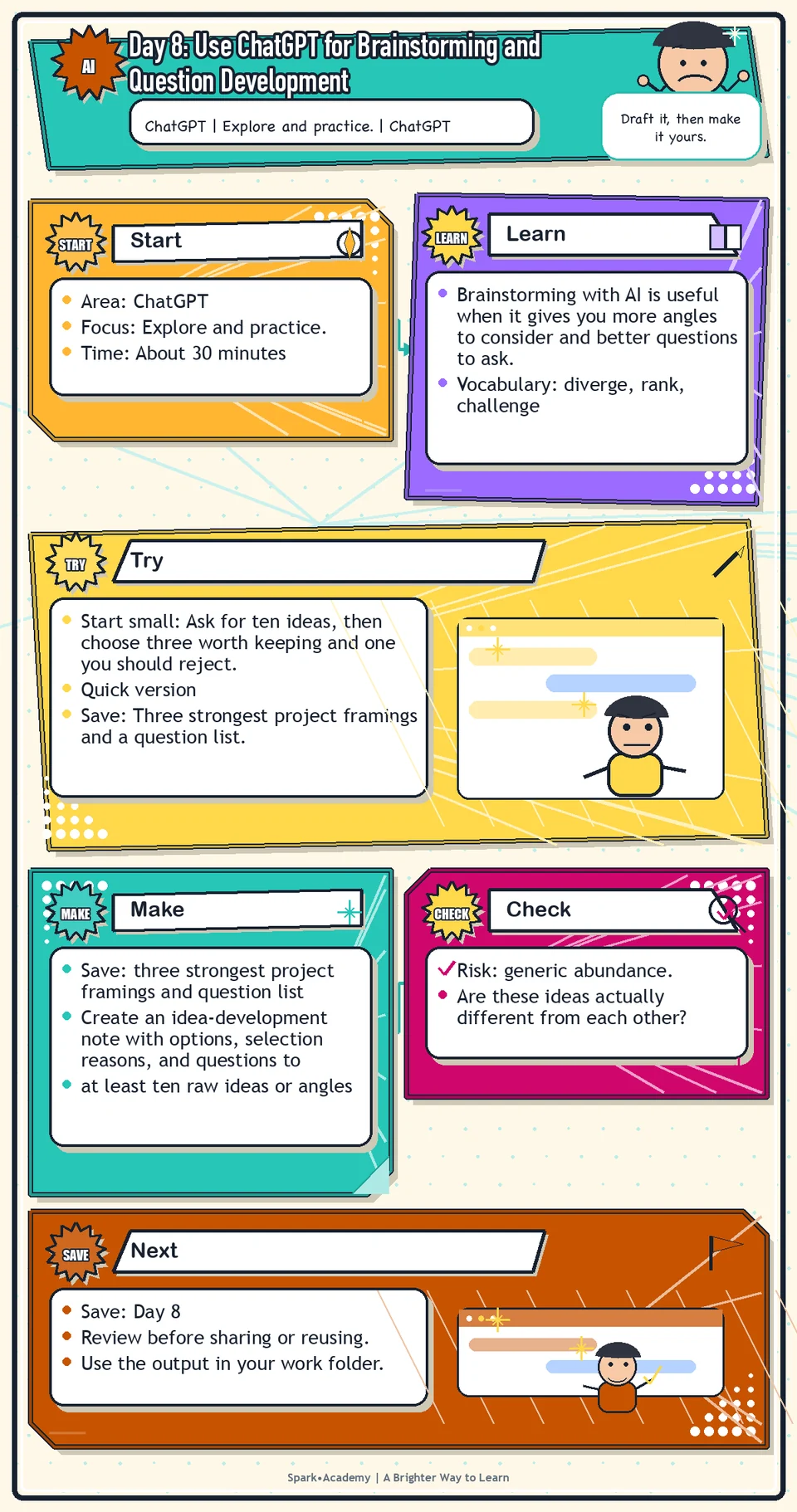
Why It Matters
Brainstorming with AI is useful when it gives you more angles to consider and better questions to ask. The point is not a long list; the point is to widen the field, then narrow it with judgment.
AI can surface audiences, objections, examples, risks, and alternate framings quickly. Your job is to filter, combine, challenge, and ground the ideas in the actual work.
Save a short set of promising directions and a sharper question list. The next decision should be easier because you can see what looks worth exploring and what evidence, constraints, or stakeholder input is still missing.
Know Before You Try
Brainstorming and question development are two different thinking moves. Brainstorming expands the field; question development narrows the uncertainty.
Divergence comes first. Use AI to generate possible angles, audiences, objections, examples, risks, and ways into the topic before choosing a direction.
Then converge. Sort the ideas, remove weak or risky ones, and turn uncertainty into questions. Strong questions identify what needs proof, what could be misunderstood, what constraints matter, and who should be consulted.
AI is useful because it can produce breadth quickly and surface blind spots. Your judgment is needed because not every idea deserves development.
A useful question is specific enough to move the work forward. "What should we say?" is too broad. "What proof do we have for this claim?" or "What would a customer misunderstand here?" is more useful. End the session with a short list of promising directions and the questions that must be answered before choosing one.
Before you try
- Brainstorming should move in two phases: first expand the possibilities, then narrow with judgment. If you narrow too early, you get obvious ideas.
- Good prompts ask for assumptions, missing questions, audience tensions, and what could go wrong, not just a list of ideas.
- Use AI to generate raw material, then use human taste and strategy to choose what is relevant, realistic, and appropriate.
Where this helps
Use this when planning rollouts, campaigns, messaging angles, point of view, media narratives, team updates, or FAQ structures.
- a message feels stuck or obvious
- you need several angles before picking a direction
- preparing questions for subject-matter, legal, technical, customer-facing, or nontechnical partners
Try It
Start small: Ask for ten ideas, then choose three worth keeping and one you should reject.
Quick version
- Save: Three strongest project framings and a question list.
- Minimum useful version: Generate ten ideas, choose three, and write one question that would test each one.
- If stuck: Sort ideas into four buckets: useful, supportable, risky, and too generic.
- Done when: You know which ideas are worth exploring and what you still need to learn.
- Add only if useful: Add a short note explaining why you rejected the weaker ideas.
Aim for
- Promising angle: "Help teams understand what the AI workflow update changes, what it does not change, and what review is still needed."
- Proof needed: Source details, approved wording, stakeholder input, and customer impact limits.
- Question to ask: "What claim would be risky or unsupported if this became a public message?"
- Why this works: It turns brainstorming into judgment instead of stopping at a long idea list.
Practice
Ask ChatGPT for ten possible project framings for a team using AI at work preparing to share a workflow update. For each angle, ask for:
- The audience.
- Why it might matter.
- What proof would be needed.
- One risk to watch.
- One reason the angle might be too generic or too hard to support.
Then ask for ten questions to ask subject-matter, legal, technical, customer-facing, and nontechnical partners before using any angle. Choose the three strongest angles and write one sentence explaining why each one is worth keeping.
Work in passes:
- Name the topic and audience.
- Ask ChatGPT for several possible angles, not just one.
- Group the ideas into categories such as emotional, practical, educational, trust-building, or operational.
- Turn the strongest ideas into questions that a real stakeholder could answer.
If the ideas are generic, ask for more constraints: "Give me ideas for a workplace audience," or "Make these less promotional and more useful to readers."
Before you save it:
- Ask for a wide list first, then ask ChatGPT to group, rank, and challenge the ideas.
- Keep at least one unusual idea long enough to understand it before you reject it.
Prompt
Primary Prompt
Use this to get a first useful draft.
Generate ten possible project framings for a team using AI at work preparing to share a workflow update. For each angle, include audience, why it matters, proof needed, one risk, and one reason it may be too generic or hard to support.Role:
Act as a strategic brainstorming partner.
Task:
Generate ten possible project framings for a team using AI at work preparing to share a workflow update. For each angle, include audience, why it matters, proof needed, one risk, and one reason it may be too generic or hard to support.
Context:
- Keep in mind: Brainstorming should expand options and sharpen questions before choosing a direction; it should not pretend early ideas are final decisions.
- Work context: brainstorming project framings.
- Save as: project framing options.
Use these details if I provide them:
- Topic.
- Audience.
- Goal.
- Proof available.
- Risks or constraints.
Ask first only if needed:
- Ask up to three clarifying questions only when missing details would materially change the answer. Otherwise, proceed with clearly labeled assumptions or placeholders.
Keep it safe:
- Use only mock, public, sanitized, or workplace-approved information. Do not include sensitive, confidential, personal, customer, legal, financial, unreleased, private-code, credential, or regulated material unless that use is explicitly approved.
- Do not invent names, dates, metrics, source content, evidence, approvals, or promises. If details are missing, use labeled placeholders or a brief mock example.
How to work:
- Generate varied framing options.
- Include audience, why it matters, proof needed, risk, and weakness for each.
- Help identify which options deserve more work.
Give me:
1. Framing options
2. Audience and importance
3. Proof and risk
4. Weak ideas to reject
5. Strongest options to develop
Style:
- Practical, clear, friendly, plain-English, specific, and non-hype.
- Use headings, bullets, or a compact table when that makes the output easier to scan.
Before you finish:
- The brainstorm should create useful choices, not a pile of polished phrases.
- Make sure the answer is usable, grounded in provided or clearly labeled mock information, and clear about what needs human review before real use.Improve Prompt
Use this to sort and challenge the brainstorm.
Review these project framings. Group similar ideas, identify the strongest three, reject the weakest three with reasons, and flag any angle that sounds generic, promotional, unsupported, or risky for the audience.Role:
Act as a brainstorming reviewer who sorts ideas by usefulness, evidence needs, audience fit, and risk.
Task:
Review these project framings. Group similar ideas, identify the strongest three, reject the weakest three with reasons, and flag any angle that sounds generic, promotional, unsupported, or risky for the audience.
Context:
- Keep in mind: Brainstorming should expand options and sharpen questions before choosing a direction; it should not pretend early ideas are final decisions.
- Work context: brainstorming project framings.
- Save as: project framing options.
Use these details if I provide them:
- Topic.
- Audience.
- Goal.
- Proof available.
- Risks or constraints.
Ask first only if needed:
- Ask up to three clarifying questions only when missing details would materially change the answer. Otherwise, proceed with clearly labeled assumptions or placeholders.
Keep it safe:
- Use only mock, public, sanitized, or workplace-approved information. Do not include sensitive, confidential, personal, customer, legal, financial, unreleased, private-code, credential, or regulated material unless that use is explicitly approved.
- Do not invent names, dates, metrics, source content, evidence, approvals, or promises. If details are missing, use labeled placeholders or a brief mock example.
How to work:
- Group similar ideas and reject weak ones.
- Identify generic, promotional, unsupported, or risky angles.
- Select the strongest options with reasons.
Give me:
1. Quick verdict
2. Issue table with priority, evidence, and recommended fix
3. Revised draft or targeted rewrite
4. Questions or approvals still needed
5. Before-use review checklist
6. Reusable review prompt pattern
Style:
- Practical, clear, friendly, plain-English, specific, and non-hype.
- Use headings, bullets, or a compact table when that makes the output easier to scan.
Before you finish:
- The brainstorm should create useful choices, not a pile of polished phrases.
- Make sure the answer is usable, grounded in provided or clearly labeled mock information, and clear about what needs human review before real use.Apply Prompt
Use this to build a reusable brainstorming pattern.
Ask me for a safe topic, audience, and goal. Then generate project framings in three categories: practical, trust-building, and future-looking. For each, include proof needed, risk, and a question to ask before using it.Role:
Act as a practical brainstorming coach who helps me generate and test project framings for a safe topic.
Task:
Ask me for a safe topic, audience, and goal. Then generate project framings in three categories: practical, trust-building, and future-looking. For each, include proof needed, risk, and a question to ask before using it.
Context:
- Keep in mind: Brainstorming should expand options and sharpen questions before choosing a direction; it should not pretend early ideas are final decisions.
- Work context: brainstorming project framings.
- Save as: project framing options.
Use these details if I provide them:
- Topic.
- Audience.
- Goal.
- Proof available.
- Risks or constraints.
Ask first only if needed:
- Ask up to three clarifying questions only when missing details would materially change the answer. Otherwise, proceed with clearly labeled assumptions or placeholders.
Keep it safe:
- Use only mock, public, sanitized, or workplace-approved information. Do not include sensitive, confidential, personal, customer, legal, financial, unreleased, private-code, credential, or regulated material unless that use is explicitly approved.
- Do not invent names, dates, metrics, source content, evidence, approvals, or promises. If details are missing, use labeled placeholders or a brief mock example.
How to work:
- Ask for topic, audience, and goal.
- Generate practical, trust-building, and future-looking framings.
- Include proof, risk, and a question before use.
Give me:
1. Questions to ask me first
2. Safe assumptions if I do not answer yet
3. Adapted project framing options
4. Review before real use
5. Reusable prompt pattern
Style:
- Practical, clear, friendly, plain-English, specific, and non-hype.
- Use headings, bullets, or a compact table when that makes the output easier to scan.
Before you finish:
- The brainstorm should create useful choices, not a pile of polished phrases.
- Make sure the answer is usable, grounded in provided or clearly labeled mock information, and clear about what needs human review before real use.Make Something Useful
Create an idea-development note with options, selection reasons, and questions to answer next.
Save three strongest project framings and question list.
Make sure it includes:
- at least ten raw ideas or angles
- three stronger ideas selected from the list
- questions that would help validate or improve the ideas
- notes about what proof or context is still missing
Review and Save
Specific risk to check: The risk today is generic abundance: many ideas that sound different but do not create real choices. Push for contrast, audience fit, and reasons to reject weaker options.
Ask whether each angle is differentiated, supportable, relevant to the audience, and aligned with strategy. Remove angles that sound generic or too promotional.
Ask yourself:
- Are these ideas actually different from each other?
- Which idea best serves the audience?
- What assumptions would I need to verify?
- Which questions would make a stakeholder conversation more useful?
Watch for
AI brainstorming can produce lots of plausible but ordinary ideas. Quantity is not the goal. Use the list to find sharper questions and stronger judgment.
More ideas are not automatically better. The value comes from using the list to notice patterns, then choosing with judgment.
Save
Save this in your 30-day work folder as Day 8 - three strongest project framings and question list.
Add a quick reuse note: Use this at work for: exploring message angles, campaign ideas, project options, or stakeholder questions before choosing a direction.
Save the raw brainstorm and the narrowed list. The raw list may be useful later, even if it does not become today's final direction.
Check yourself
- I generated multiple project framings.
- I identified the audience for each angle.
- I identified possible proof points and risks.
- I created questions for subject-matter, legal, technical, customer-facing, and nontechnical partners.
- I selected the strongest ideas instead of accepting all ideas.
- I understand that brainstorming creates options, not final decisions.
- I can explain why I chose my strongest ideas and what questions still need answers.
- I can turn a brainstorm into stronger options and questions that help a real work decision.
Optional video
Watch: 5 More ChatGPT Prompts to Add to Your Collection (official OpenAI YouTube channel, 0:57).
Why it helps: It gives quick examples of prompting patterns that can help people expand beyond one-shot brainstorming.