Day 18: Produce a Source Based Briefing
What you will learn and leave with
This lesson focuses on produce a source based briefing. It uses Gemini Notebook as a practical context while keeping privacy, accuracy, context, and human judgment in charge.
Use this when: you need a practical, reviewable next step. By the end: you will save source-based briefing with review flags.
Source check: product features and interfaces can change. Gemini Notebook Help Center was checked for this course on 2026-08-19; confirm current details before using a changing feature.
Listen to the Day 18 Introduction
This short audio introduces the day and what to focus on.
Day 18: Produce a Source Based Briefing audio transcript
A briefing is not just a summary with fewer words.
A good briefing helps someone understand the situation, see what matters, and know what questions or actions should come next.
Welcome to Day 18 of the 30-Day AI at Work Challenge: Produce a Source Based Briefing.
Today, you will turn source material into a short decision-support briefing. The reader might be a manager, teammate, reviewer, or stakeholder who needs the important points without losing the limits.
Let's start with the structure. A useful briefing separates facts, implications, open questions, and next steps.
Facts come from the source. Implications explain what those facts may mean. Open questions name what is still unknown. Next steps suggest what should happen before the work moves forward.
That separation matters because busy readers can easily mistake a confident implication for an approved fact.
The risk today is hiding uncertainty. If a briefing smooths over source gaps, review needs, or unresolved decisions, it may feel helpful while creating confusion later.
The lesson includes a worked example. Notice how it names the reader, gives context, shares key takeaways, and keeps source facts separate from what still needs review.
In your own practice, choose a safe source or notebook. Ask for a briefing, then revise it so the reader can skim it quickly and still see the limits.
Before you begin, think about someone who might need a briefing from you. What would they need first: the facts, the risk, the recommendation, or the open questions?
By the end, you will save a source-based briefing with review flags. The goal is not just shorter information. It is information someone can use responsibly.
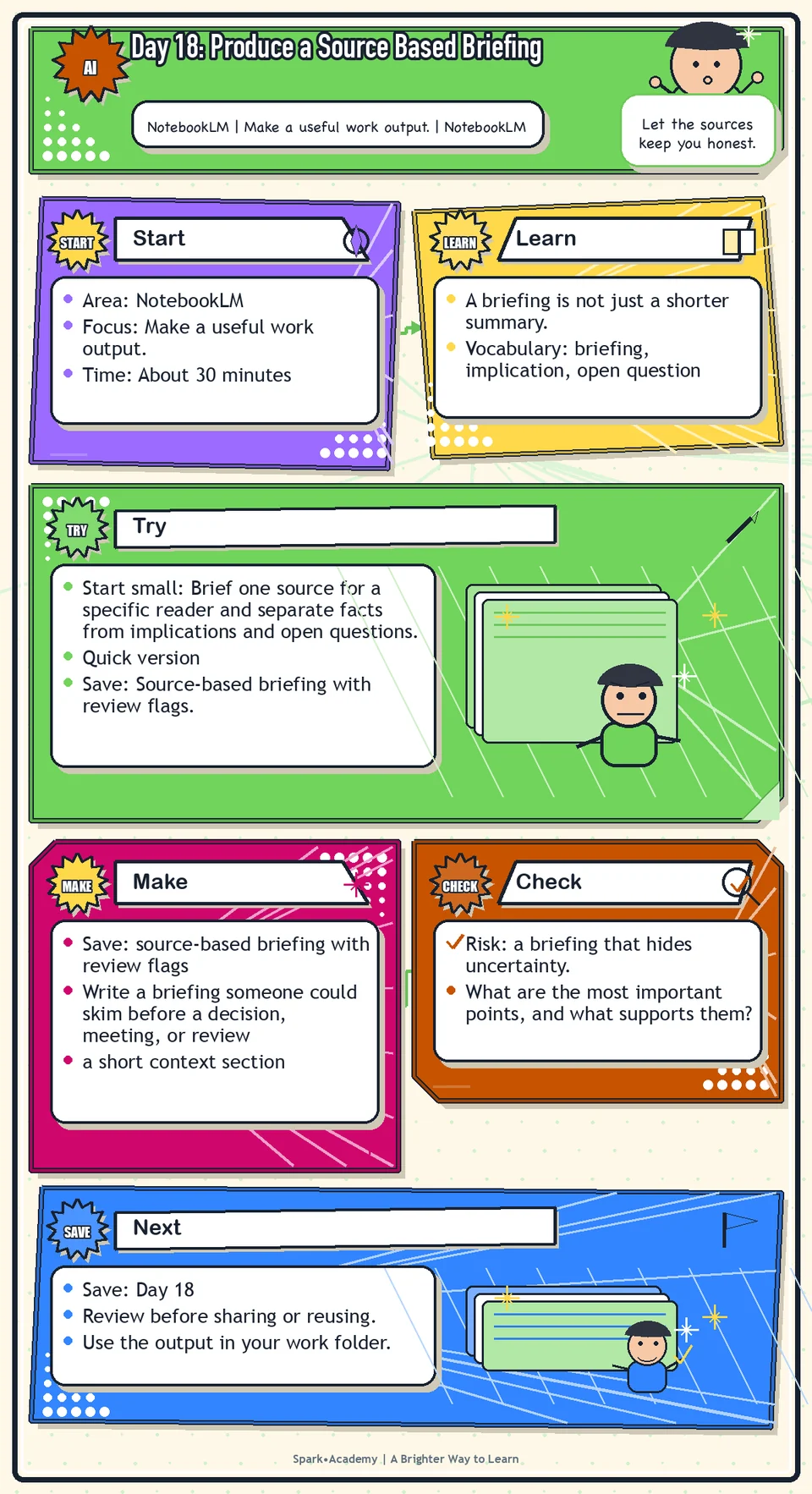
Why It Matters
A briefing is not just a shorter summary. It helps someone understand the situation, see why it matters, ask better questions, and decide what action or review is needed.
Busy readers need facts, evidence, implications, open questions, risks, and next steps in a compact format. They also need to know what is uncertain or unsupported.
Save a briefing that is concise, evidence-aware, and honest about limits. It should make source material usable without hiding caveats or presenting implications as confirmed facts.
Know Before You Try
A source-based briefing should separate what the source says, what it implies, what remains unknown, and what the next step should be.
Use four lanes: facts, interpretations, open questions, and recommended next steps. Keeping those lanes separate prevents a briefing from sounding more certain than the source allows.
Facts come from the source. Interpretations explain what the facts may mean. Open questions name what is still unknown. Recommended next steps suggest what to do with the information.
A useful briefing usually includes context, key points, evidence, impact, risks, open questions, and next steps. It should be short enough to read quickly but specific enough to be useful.
The briefing should help a reader act, not just learn. It should make clear what the reader needs to understand, what decision or discussion may follow, and what questions still need answers.
If the source does not support a point, mark it as an assumption, implication, or question rather than presenting it as fact. The best briefings are concise and honest about uncertainty.
Before you try
- A source-based briefing is not just a summary. It is a decision-support document for a specific reader.
- Good briefings usually include context, key points, evidence, implications, open questions, and recommended next steps or review needs.
- Use Gemini Notebook for source grounding, then use your workplace judgment to decide what the reader needs first.
Where this helps
Use this before project planning meetings, product messaging sessions, domain reviews, media prep, or getting oriented discussions.
- before meeting with subject-matter, legal, technical, or other review partners
- preparing background for a work plan
- turning several sources into a concise decision-support document
Try It
Start small: Brief one source for a specific reader and separate facts from implications and open questions.
Quick version
- Save: Source-based briefing with review flags.
- Minimum useful version: Write four lanes: facts, implications, open questions, and next steps.
- If stuck: "Fact: the source says X. Implication: this may matter because Y. Open question: what has not been confirmed?"
- Done when: A reader can tell what is sourced, what is interpretation, and what needs verification.
- Add only if useful: Add one sentence about who should review the briefing before real use.
Aim for
- Fact: "The source describes three stages in the workflow."
- Interpretation: "This may help explain why the update affects multiple teams."
- Open question: "Which teams are affected first?"
- Next step: "Confirm scope with the project owner before drafting a broader message."
Practice
Choose one notebook. Ask Gemini Notebook to create a short briefing on the most important themes in the sources. Ask it to include:
- Key points.
- Open questions.
- Risks.
- Source-based facts.
- Possible work implications.
- What needs attention.
Then ask for three possible learning aids that would help you learn the topic better. Save the best briefing and mark which parts are source facts, which parts are interpretations, and which parts need review.
Work in passes:
- Ask Gemini Notebook for key takeaways from the source set.
- Ask for risks, open questions, and possible stakeholder concerns.
- Turn the result into a briefing structure: context, takeaways, implications, questions, next steps.
- Review the source support for the most important points.
If the briefing feels like a generic summary, add a purpose: "Brief me so I can prepare workplace questions for a workflow review." Purpose makes the output sharper.
Before you save it:
- Write the reader and decision at the top before drafting the briefing.
- Check whether each key point has a source, an implication, or a review flag.
Prompt
Primary Prompt
Use this to get a first useful draft.
Using only the sources in this notebook, create a short source-based briefing with key points, open questions, risks, source-based facts, possible work implications, and what needs attention.Role:
Act as a briefing writer who respects source limits.
Task:
Using only the sources in this notebook, create a short source-based briefing with key points, open questions, risks, source-based facts, possible work implications, and what needs attention.
Context:
- Keep in mind: A source-based briefing should separate facts, implications, assumptions, risks, unknowns, and next steps so readers do not confuse evidence with recommendations.
- Work context: source-based briefing.
- Save as: source-based briefing with review flags.
Use these details if I provide them:
- Notebook sources.
- Audience.
- Decision or discussion need.
- Risks and open questions.
Ask first only if needed:
- Ask up to three clarifying questions only when missing details would materially change the answer. Otherwise, proceed with clearly labeled assumptions or placeholders.
Keep it safe:
- Use only mock, public, sanitized, or workplace-approved information. Do not include sensitive, confidential, personal, customer, legal, financial, unreleased, private-code, credential, or regulated material unless that use is explicitly approved.
- Do not invent names, dates, metrics, source content, evidence, approvals, or promises. If details are missing, use labeled placeholders or a brief mock example.
How to work:
- Create a briefing with key points, facts, open questions, risks, and implications.
- Separate source facts from interpretation.
- Mark what needs attention.
Give me:
1. Briefing purpose
2. Key points
3. Source-supported facts
4. Risks and open questions
5. Work implications
6. Review needs
Style:
- Practical, clear, friendly, plain-English, specific, and non-hype.
- Use headings, bullets, or a compact table when that makes the output easier to scan.
Before you finish:
- The briefing should help someone act without hiding uncertainty.
- Make sure the answer is usable, grounded in provided or clearly labeled mock information, and clear about what needs human review before real use.Improve Prompt
Use this to make the briefing more review-ready.
Review this source-based briefing. Separate facts, implications, risks, assumptions, and open questions. Flag any claim that needs a citation, a stronger source, or subject-matter review before it is shared.Role:
Act as a source-based briefing reviewer who separates facts, implications, assumptions, risks, and open questions.
Task:
Review this source-based briefing. Separate facts, implications, risks, assumptions, and open questions. Flag any claim that needs a citation, a stronger source, or subject-matter review before it is shared.
Context:
- Keep in mind: A source-based briefing should separate facts, implications, assumptions, risks, unknowns, and next steps so readers do not confuse evidence with recommendations.
- Work context: source-based briefing.
- Save as: source-based briefing with review flags.
Use these details if I provide them:
- Notebook sources.
- Audience.
- Decision or discussion need.
- Risks and open questions.
Ask first only if needed:
- Ask up to three clarifying questions only when missing details would materially change the answer. Otherwise, proceed with clearly labeled assumptions or placeholders.
Keep it safe:
- Use only mock, public, sanitized, or workplace-approved information. Do not include sensitive, confidential, personal, customer, legal, financial, unreleased, private-code, credential, or regulated material unless that use is explicitly approved.
- Do not invent names, dates, metrics, source content, evidence, approvals, or promises. If details are missing, use labeled placeholders or a brief mock example.
How to work:
- Review the briefing for unsupported claims and mixed categories.
- Separate facts, implications, assumptions, risks, and open questions.
- Flag source and review needs.
Give me:
1. Quick verdict
2. Issue table with priority, evidence, and recommended fix
3. Revised draft or targeted rewrite
4. Questions or approvals still needed
5. Before-use review checklist
6. Reusable review prompt pattern
Style:
- Practical, clear, friendly, plain-English, specific, and non-hype.
- Use headings, bullets, or a compact table when that makes the output easier to scan.
Before you finish:
- The briefing should help someone act without hiding uncertainty.
- Make sure the answer is usable, grounded in provided or clearly labeled mock information, and clear about what needs human review before real use.Apply Prompt
Use this to brief a specific audience.
Ask me who the briefing is for and what decision or discussion it should support. Then create a source-based briefing using only notebook sources, with key points, evidence, risks, open questions, and recommended next step.Role:
Act as a practical briefing coach who helps me adapt a source-based briefing to an audience and decision need.
Task:
Ask me who the briefing is for and what decision or discussion it should support. Then create a source-based briefing using only notebook sources, with key points, evidence, risks, open questions, and recommended next step.
Context:
- Keep in mind: A source-based briefing should separate facts, implications, assumptions, risks, unknowns, and next steps so readers do not confuse evidence with recommendations.
- Work context: source-based briefing.
- Save as: source-based briefing with review flags.
Use these details if I provide them:
- Notebook sources.
- Audience.
- Decision or discussion need.
- Risks and open questions.
Ask first only if needed:
- Ask up to three clarifying questions only when missing details would materially change the answer. Otherwise, proceed with clearly labeled assumptions or placeholders.
Keep it safe:
- Use only mock, public, sanitized, or workplace-approved information. Do not include sensitive, confidential, personal, customer, legal, financial, unreleased, private-code, credential, or regulated material unless that use is explicitly approved.
- Do not invent names, dates, metrics, source content, evidence, approvals, or promises. If details are missing, use labeled placeholders or a brief mock example.
How to work:
- Ask who the briefing is for and what it should support.
- Create a source-based briefing with evidence and next step.
- Stay inside notebook sources.
Give me:
1. Questions to ask me first
2. Safe assumptions if I do not answer yet
3. Adapted source-based briefing with review flags
4. Review before real use
5. Reusable prompt pattern
Style:
- Practical, clear, friendly, plain-English, specific, and non-hype.
- Use headings, bullets, or a compact table when that makes the output easier to scan.
Before you finish:
- The briefing should help someone act without hiding uncertainty.
- Make sure the answer is usable, grounded in provided or clearly labeled mock information, and clear about what needs human review before real use.Make Something Useful
Write a briefing someone could skim before a decision, meeting, or review conversation.
Save source-based briefing with review flags.
Make sure it includes:
- a short context section
- three to five key takeaways
- source-supported evidence or details
- risks, open questions, and next steps
Worked example: source-based briefing
Reader: Manager preparing for a project review.
Context: The source describes a draft AI-assisted intake workflow for internal support requests.
Key takeaways:
- The workflow is intended to help sort incoming requests by topic and urgency.
- The source describes an internal pilot, not a fully approved rollout.
- The main unresolved issues are review ownership, privacy guidance, and escalation rules.
Facts from the source: The pilot is internal, the support team is testing categories, and the escalation process is still being defined.
Implications: The team can discuss the workflow as an experiment, but should not describe it as launched, proven, or customer-ready.
Open questions: Who approves category labels? What data can be used? What review is needed before broader sharing?
Why this works: It separates source facts, implications, and open questions so a busy reader can act without mistaking uncertainty for approval.
Review and Save
Specific risk to check: The risk today is a briefing that hides uncertainty. Busy readers need facts, implications, open questions, and review needs separated clearly.
Mark anything that needs verification. Do not use source-based output as approved messaging unless it has gone through the right review.
Ask yourself:
- What are the most important points, and what supports them?
- What would I need to verify before sharing this?
- Are assumptions clearly labeled?
- Does the briefing help someone decide what to ask or do next?
Watch for
A briefing can be accurate and still not be strategic. After Gemini Notebook summarizes the source, use your judgment or ChatGPT to shape what it means for the work.
Do not let the briefing become a dumping ground. If everything is important, nothing is important. Choose what the reader needs most.
Save
Save this in your 30-day work folder as Day 18 - source-based briefing with review flags.
Add a quick reuse note: Use this at work for: briefing a teammate, manager, or reviewer on what sources say, what they do not answer, and what needs action.
Save the briefing with the topic, date, and source set. Briefings age, so the date matters.
Check yourself
- I chose one Gemini Notebook notebook.
- I created a source-based briefing.
- I separated key points from open questions and risks.
- I identified what needs attention.
- I marked anything that needs verification or human review.
- I saved the briefing in a format I could reuse.
- I can explain how my briefing differs from a simple summary.
- I can create a briefing that separates facts, implications, open questions, and next steps.