Day 10: Use ChatGPT for Pressure Testing and Claim Discipline
What you will learn and leave with
This lesson teaches you how to use ChatGPT for pressure testing and claim discipline. It uses ChatGPT as a practical learning context while keeping privacy, accuracy, context, and human judgment in charge.
Use this when: you want guided practice with ChatGPT before applying it to real work. By the end: you will save pressure-tested message and grounded rewrite.
Course position: Day 10 of 30 · ChatGPT module
Continue: Day 11: Produce a Safer, Clearer Message
Source check: product features and interfaces can change. OpenAI ChatGPT Help Center was checked for this course on 2026-08-30; confirm current details before using a changing feature.
Listen to the Day 10 Introduction
This short audio introduces the day and what to focus on.
Day 10: Use ChatGPT for Pressure Testing and Claim Discipline audio transcript
Sometimes the most risky sentence in a draft is the one that sounds the most confident.
That is why today is about slowing down before you share.
Welcome to Day 10 of the 30-Day AI at Work Challenge: Use ChatGPT for Pressure Testing and Claim Discipline.
Today, you will use ChatGPT as a critical reviewer, not just a drafting helper. The point is to find where a message may be unclear, unsupported, too broad, or too certain.
Let's start with claim discipline. A claim is anything your message says or strongly implies. Some claims are simple facts. Some are interpretations. Some are benefits, promises, or predictions. The stronger the claim, the stronger the support needs to be.
That matters a lot in workplace communication, especially around AI, product changes, customer impact, trust, access, outcomes, or public-facing language.
ChatGPT can help you pressure test a draft by asking what the source actually supports, what the draft implies, and what needs human review. But it cannot approve the claim for you.
The risk today is overreach. Watch for words like guarantees, proves, eliminates, fully automates, or best. Those words may sound strong, but they can create promises the evidence does not support.
In the lesson, you will find risky or vague claims, rewrite them more carefully, and mark what needs verification.
Before you begin, think of one sentence you have seen that sounded impressive but made you wonder, "Can we really say that?"
By the end, you will save a pressure-tested message and a grounded rewrite. The goal is not weaker writing. It is language whose confidence matches the evidence.
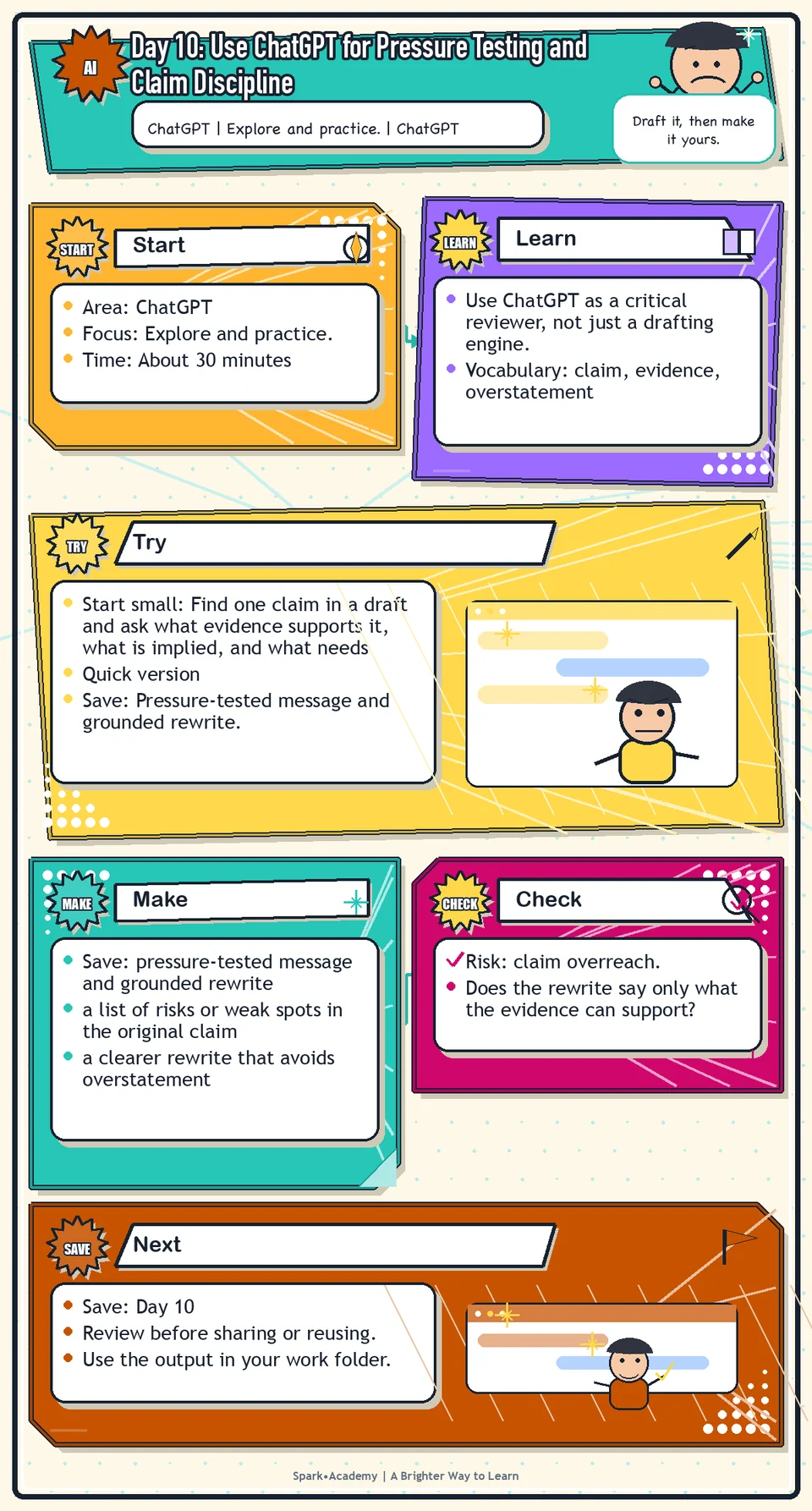
Why It Matters
Use ChatGPT as a critical reviewer, not just a drafting engine. Ask it to separate what the source supports, what the draft implies, what is overstated, and what needs human review.
Polished writing can make weak evidence sound stronger than it is. This is risky in messages about customers, products, performance, AI, public claims, or anything that may be reviewed closely.
Save a claim review that identifies unsupported claims, vague promises, missing evidence, risky wording, and approval needs. The point is not to make every message cautious; it is to make confidence match the facts.
Know Before You Try
Pressure testing means looking at a message from multiple perspectives before it creates confusion, risk, or overstatement. Claim discipline means making sure the language does not say more than the source material supports.
Use the claim ladder: fact, interpretation, recommendation, aspiration, and promise. The higher the claim sits on the ladder, the more evidence and review it needs.
Pressure testing asks, "How could this be misunderstood?" Claim discipline asks, "What can we actually support?" Together, they catch vague promises, unsupported claims, missing evidence, unclear audiences, and places where human review is needed.
The point is not to make every message cautious or bland. The point is to make sure confidence is earned by the facts and that readers are not led to believe more than the source material supports.
A grounded rewrite should be clearer, more specific, and less likely to imply more than the facts support. Good review removes exaggeration without making the message lifeless.
Before you try
- Pressure testing is where you slow the draft down and ask whether each claim is supported, appropriately qualified, and safe for the audience.
- In AI or regulated communication, small wording choices matter. Words like proves, guarantees, prevents, eliminates, and fully automates can create claims the evidence may not support.
- Ask AI to identify risk, but do not ask AI to be the final legal, domain, product, or compliance reviewer. It can help prepare the review; it cannot replace it.
Where this helps
Use this before sharing messages about AI, regulated topics, customer impact, product capabilities, partnerships, outcomes, performance, access, or trust.
- before writing about AI, regulated topics, customer impact, outcomes, access, trust, or product capabilities
- before sharing public-facing or high-stakes language
- a sentence sounds strong but you are not sure whether it is supported
Try It
Start small: Find one claim in a draft and ask what evidence supports it, what is implied, and what needs review.
Quick version
- Save: Pressure-tested message and grounded rewrite.
- Minimum useful version: Tag three claims as fact, interpretation, recommendation, aspiration, or promise, then rewrite the riskiest one.
- If stuck: "Redefining customer support" is an aspiration or promise unless the source proves it.
- Done when: The rewrite sounds clear without claiming more than the evidence supports.
- Add only if useful: Add reviewer notes for customer, legal, technical, and skeptical-reader perspectives.
Aim for
- Risky claim: "We are redefining customer support with AI-powered tools."
- Claim type: Aspiration or promise.
- Grounded rewrite: "We are exploring AI-supported tools that may help teams organize support information more clearly, pending review and validation."
- Why this works: The rewrite keeps the useful idea while lowering unsupported certainty.
Practice
Use this draft: "A mock workplace is redefining customer support with AI-powered tools." Ask ChatGPT to critique it from the perspective of:
- A customer.
- A subject-matter expert.
- A journalist.
- An investor.
- A regulator.
- An teammate.
- A skeptic.
Then ask what works, what is unclear, what sounds unsupported, what could be misunderstood, and what should improve. Finally, ask for a clearer, more grounded rewrite and compare it against the original.
Work in passes:
- Start with the provided claim and ask for critiques from multiple perspectives.
- Ask ChatGPT to separate clarity problems from evidence problems.
- Request a rewrite that is more precise and less absolute.
- Write down what evidence or human review would be needed before real use.
If the critique feels too soft, ask the model to be stricter about unsupported claims, implied regulatory or user outcomes, regulatory sensitivity, and reader misunderstanding. If it becomes too harsh, ask it to preserve the strongest truthful point.
Before you save it:
- Highlight every claim in the draft and mark it as sourced, needs source, opinion, or remove.
- Ask ChatGPT to find overstatement, then compare its answer against your own judgment and the source material.
Prompt
Primary Prompt
Use this to get a first useful draft.
Critique this draft from the perspective of a customer, subject-matter expert, journalist, investor, regulator, teammate, and skeptic: a safe or mock workplace is redefining customer support with AI-powered tools. Identify what works, what is unclear, what sounds unsupported, what could be misunderstood, and how to make it clearer and more grounded.Role:
Act as a strict but helpful message reviewer.
Task:
Critique this draft from the perspective of a customer, subject-matter expert, journalist, investor, regulator, teammate, and skeptic: a safe or mock workplace is redefining customer support with AI-powered tools. Identify what works, what is unclear, what sounds unsupported, what could be misunderstood, and how to make it clearer and more grounded.
Context:
- Keep in mind: Pressure testing and claim discipline help prevent overstatement by checking claims from multiple reader perspectives before use.
- Work context: pressure testing claims and claim discipline.
- Save as: pressure-tested message and grounded rewrite.
Use these details if I provide them:
- Draft text.
- Audience.
- Available evidence.
- Sensitive claims.
- Reviewers.
Ask first only if needed:
- Ask up to three clarifying questions only when missing details would materially change the answer. Otherwise, proceed with clearly labeled assumptions or placeholders.
Keep it safe:
- Use only mock, public, sanitized, or workplace-approved information. Do not include sensitive, confidential, personal, customer, legal, financial, unreleased, private-code, credential, or regulated material unless that use is explicitly approved.
- Do not invent names, dates, metrics, source content, evidence, approvals, or promises. If details are missing, use labeled placeholders or a brief mock example.
How to work:
- Critique the draft from multiple perspectives.
- Separate what works from what is unclear, unsupported, or easy to misunderstand.
- Create a grounded rewrite.
Give me:
1. Perspective-by-perspective critique
2. Unsupported, vague, or risky claims
3. Evidence and questions needed
4. Safer grounded rewrite
5. Review gates before use
6. Reusable pressure-test prompt pattern
Style:
- Practical, clear, friendly, plain-English, specific, and non-hype.
- Use headings, bullets, or a compact table when that makes the output easier to scan.
Before you finish:
- The critique should make the message safer and clearer without making it lifeless.
- Make sure the answer is usable, grounded in provided or clearly labeled mock information, and clear about what needs human review before real use.Improve Prompt
Use this to separate claim types.
Mark each claim in this draft as sourced, needs source, opinion, vague, risky, or remove. Then suggest a rewrite that keeps the strongest supportable point while removing unsupported promises and unclear implications.Role:
Act as a claim-discipline reviewer who checks each claim for support, risk, ambiguity, and overstatement.
Task:
Mark each claim in this draft as sourced, needs source, opinion, vague, risky, or remove. Then suggest a rewrite that keeps the strongest supportable point while removing unsupported promises and unclear implications.
Context:
- Keep in mind: Pressure testing and claim discipline help prevent overstatement by checking claims from multiple reader perspectives before use.
- Work context: pressure testing claims and claim discipline.
- Save as: pressure-tested message and grounded rewrite.
Use these details if I provide them:
- Draft text.
- Audience.
- Available evidence.
- Sensitive claims.
- Reviewers.
Ask first only if needed:
- Ask up to three clarifying questions only when missing details would materially change the answer. Otherwise, proceed with clearly labeled assumptions or placeholders.
Keep it safe:
- Use only mock, public, sanitized, or workplace-approved information. Do not include sensitive, confidential, personal, customer, legal, financial, unreleased, private-code, credential, or regulated material unless that use is explicitly approved.
- Do not invent names, dates, metrics, source content, evidence, approvals, or promises. If details are missing, use labeled placeholders or a brief mock example.
How to work:
- Mark each claim as sourced, needs source, opinion, vague, risky, or remove.
- Preserve the strongest supportable point.
- Remove unsupported promises and unclear implications.
Give me:
1. Quick verdict
2. Issue table with priority, evidence, and recommended fix
3. Revised draft or targeted rewrite
4. Questions or approvals still needed
5. Before-use review checklist
6. Reusable review prompt pattern
Style:
- Practical, clear, friendly, plain-English, specific, and non-hype.
- Use headings, bullets, or a compact table when that makes the output easier to scan.
Before you finish:
- The critique should make the message safer and clearer without making it lifeless.
- Make sure the answer is usable, grounded in provided or clearly labeled mock information, and clear about what needs human review before real use.Apply Prompt
Use this for your own safe draft.
Ask me for a safe, approved, or mock draft and the audience. Then pressure test it from three reader perspectives, identify unsupported claims, and create a grounded rewrite with notes about what needs human review.Role:
Act as a practical pressure-testing coach who helps me review a safe draft from realistic reader perspectives.
Task:
Ask me for a safe, approved, or mock draft and the audience. Then pressure test it from three reader perspectives, identify unsupported claims, and create a grounded rewrite with notes about what needs human review.
Context:
- Keep in mind: Pressure testing and claim discipline help prevent overstatement by checking claims from multiple reader perspectives before use.
- Work context: pressure testing claims and claim discipline.
- Save as: pressure-tested message and grounded rewrite.
Use these details if I provide them:
- Draft text.
- Audience.
- Available evidence.
- Sensitive claims.
- Reviewers.
Ask first only if needed:
- Ask up to three clarifying questions only when missing details would materially change the answer. Otherwise, proceed with clearly labeled assumptions or placeholders.
Keep it safe:
- Use only mock, public, sanitized, or workplace-approved information. Do not include sensitive, confidential, personal, customer, legal, financial, unreleased, private-code, credential, or regulated material unless that use is explicitly approved.
- Do not invent names, dates, metrics, source content, evidence, approvals, or promises. If details are missing, use labeled placeholders or a brief mock example.
How to work:
- Ask for a safe draft and audience.
- Pressure test it from reader perspectives.
- Create a grounded rewrite with review notes.
Give me:
1. Questions to ask me first
2. Safe assumptions if I do not answer yet
3. Adapted pressure-tested message and grounded rewrite
4. Review before real use
5. Reusable prompt pattern
Style:
- Practical, clear, friendly, plain-English, specific, and non-hype.
- Use headings, bullets, or a compact table when that makes the output easier to scan.
Before you finish:
- The critique should make the message safer and clearer without making it lifeless.
- Make sure the answer is usable, grounded in provided or clearly labeled mock information, and clear about what needs human review before real use.Make Something Useful
Save a claim review record that shows the original risk, the grounded rewrite, and what must be verified.
Save pressure-tested message and grounded rewrite.
Make sure it includes:
- a list of risks or weak spots in the original claim
- a clearer rewrite that avoids overstatement
- notes about what proof is missing
- a list of reviewers who should see the message before real use
Review and Save
Specific risk to check: The risk today is claim overreach. Watch for superlatives, guarantees, broad outcome language, and confident wording that outruns the evidence.
Look for unsupported superlatives, vague claims, unclear audience, regulatory sensitivity, implied regulatory or user outcomes, and language that sounds broader than what the workplace can prove.
Ask yourself:
- Does the rewrite say only what the evidence can support?
- Could a reader infer a domain, legal, or product promise we did not mean?
- Have I removed vague superlatives or explained them with proof?
- Would I be comfortable explaining where this claim came from?
Watch for
AI can identify possible risks, but it is not legal, domain, or regulatory review. It can help prepare for review. It cannot replace review.
Do not use pressure testing to make every sentence timid. Use it to make confidence more earned. A strong message can still be warm and compelling when it is specific and supportable.
Save
Save this in your 30-day work folder as Day 10 - pressure-tested message and grounded rewrite.
Add a quick reuse note: Use this at work for: reviewing claims in a message, announcement, FAQ, web page, or AI-related statement before sharing.
Save the original claim, critique, and rewrite together. The contrast is the day.
Check yourself
- I pressure tested a message from multiple perspectives.
- I identified unclear or unsupported language.
- I identified possible audience concerns.
- I revised the message to be clearer and more grounded.
- I understand that AI review does not replace legal, domain, product, or appropriate review.
- I know why claim discipline matters in workplace communication.
- I can identify the difference between a strong claim and an unsupported claim.
- I can pressure test a claim and revise it so confidence matches the available evidence.
Optional video
Watch: 5 More ChatGPT Prompts to Add to Your Collection (official OpenAI YouTube channel, 0:57).
Why it helps: It shows quick prompting patterns you can adapt for critique, revision, and follow-up questions.