Day 26: Use Codex for Technical Translation
Listen to the Day 26 Introduction
This short audio introduces the day and what to focus on.
Why It Matters
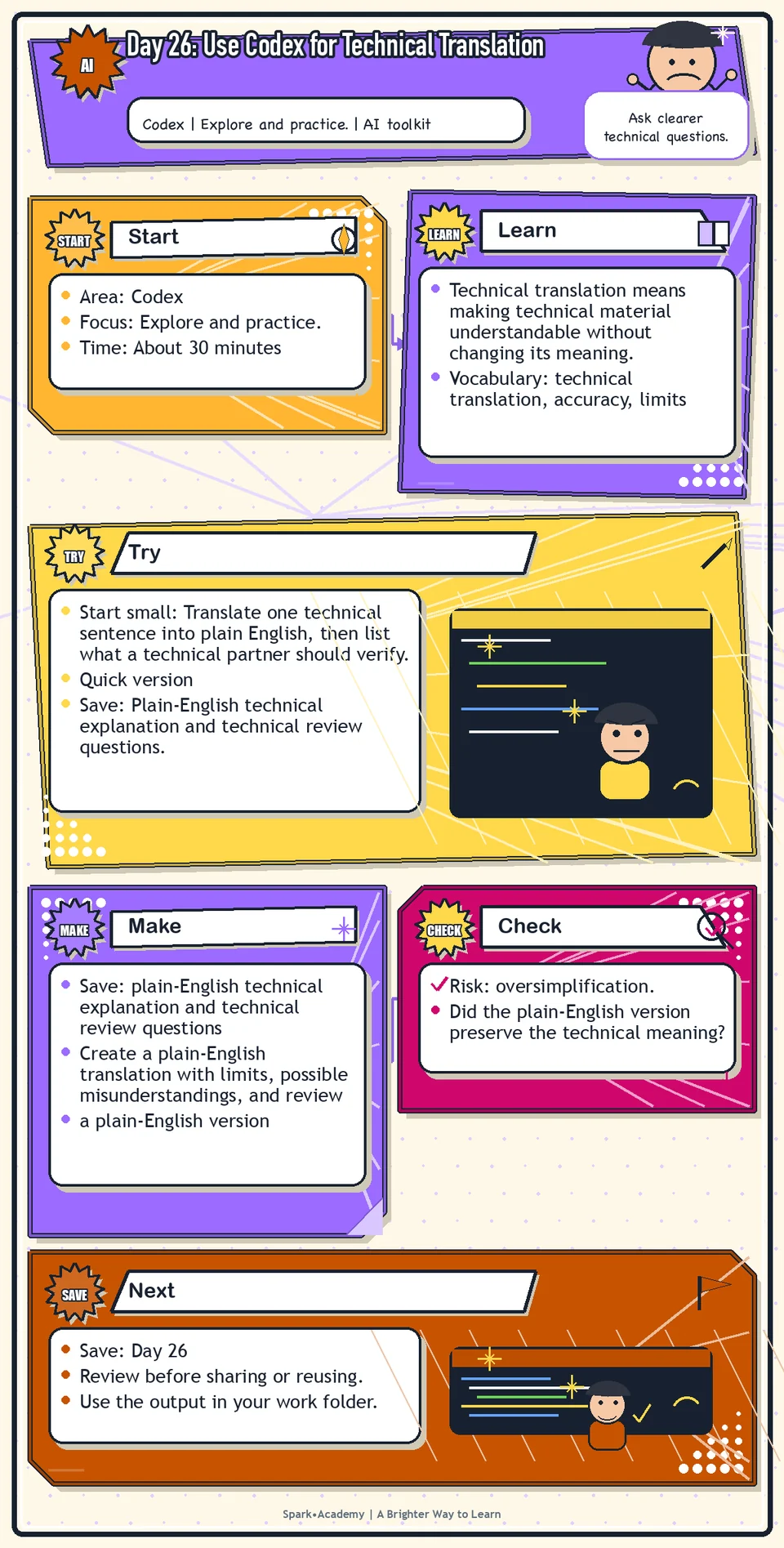
Technical translation means making technical material understandable without changing its meaning. The challenge is to simplify language, structure, examples, and level of detail while preserving truth.
Bad technical communication fails in two directions: it drowns readers in jargon or oversimplifies until the explanation becomes wrong. Good translation keeps necessary terms, removes unnecessary complexity, and makes limits visible.
Save a plain-English explanation with review questions. It should be simpler and more readable while still faithful to what a technical partner would recognize as accurate.
Know Before You Try
Good technical translation preserves truth while changing form. It makes the idea accurate, clear, and useful for the audience.
Plain English is not less precise English. It means choosing words, structure, and examples that help the intended audience understand the point without changing the meaning.
A strong translation answers: What does this do? Why does it matter? Who is affected? What terms need defining? What limitations matter? What could be misunderstood? What should we avoid claiming?
Examples and analogies can help, but they must be used carefully. A simple analogy is useful only if it clarifies the concept without hiding important constraints.
Technical translation is usually not the final approval step. If the explanation will guide messaging, customers, policy, security, or product decisions, confirm it with the appropriate expert before sharing. The test is whether an expert would say the explanation is simpler but still true.
Before you try
- Technical translation means preserving accuracy while changing the level of explanation. It is not simplifying so much that the meaning changes.
- Ask Codex to separate what the system does, why it matters, dependencies, limitations, risks, and what a non-technical stakeholder should ask next.
- When the topic involves architecture, security, data, APIs, models, or reliability, mark uncertainty clearly and get technical review.
Where this helps
Use this before writing about features, AI capabilities, integrations, infrastructure, data flows, model behavior, or product limitations.
- preparing product explainers, FAQs, project notes, team updates, or stakeholder briefings
- technical language may confuse non-technical readers
- you need to ask engineers whether a simplification is accurate
Try It
Start small: Translate one technical sentence into plain English, then list what a technical partner should verify.
Quick version
- Save: Plain-English technical explanation and technical review questions.
- Minimum useful version: Create one paragraph explanation, three-term glossary, and three questions for technical review.
- If stuck: Compare three versions: too technical, too simplified, and accurate plain English.
- Done when: The explanation is easier to read without changing the technical meaning.
- Add only if useful: Add one sentence about what the explanation should not claim yet.
Aim for
- Too technical: "The service calls an endpoint that returns normalized intent categories."
- Too simplified: "The system understands what every customer wants."
- Better plain English: "The system groups incoming requests into categories that a support workflow can use, but a technical partner should confirm how accurate and complete those categories are."
- Why this works: It is simpler without becoming false.
Practice
Use a short technical note, product flow, or architecture paragraph. For practice, use mock, public, or sanitized material. Ask Codex or ChatGPT to explain it for a nontechnical reader. Ask it to focus on:
- What it does.
- Why it matters.
- What could be misunderstood.
- What cannot be claimed yet.
- What questions to ask engineering.
Then ask for three versions:
- One sentence.
- One paragraph.
- Five bullet points.
Compare the versions and decide which one is most useful for the audience.
Work in passes:
- Paste or describe safe technical material.
- Ask Codex for a plain-English explanation.
- Ask it to list jargon, assumptions, and possible misunderstandings.
- Create your own final version and mark what needs expert review.
If the translation feels too loose, ask Codex to stay closer to the source. If it feels too technical, ask for examples or analogies, but review analogies carefully because they can oversimplify.
Before you save it:
- Ask for both a beginner explanation and a more precise technical explanation, then compare them.
- Flag any sentence where you are not sure whether the simplified wording is still technically true.
Prompt
Primary Prompt
Use this to get a first useful draft.
Explain this safe or mock technical material for a nontechnical reader. Cover what it does, why it matters, what could be misunderstood, what cannot be claimed yet, and questions to ask engineering. Give me one-sentence, one-paragraph, and five-bullet versions.Role:
Act as a plain-English technical translator.
Task:
Explain this safe or mock technical material for a nontechnical reader. Cover what it does, why it matters, what could be misunderstood, what cannot be claimed yet, and questions to ask engineering. Give me one-sentence, one-paragraph, and five-bullet versions.
Context:
- Keep in mind: Good technical translation preserves truth while making the idea clearer for the audience and marking what cannot be claimed yet.
- Work context: plain-English technical translation.
- Save as: plain-English technical explanation.
Use these details if I provide them:
- Safe technical material.
- Reader role.
- Sensitive claims.
- Engineering questions.
Ask first only if needed:
- Ask up to three clarifying questions only when missing details would materially change the answer. Otherwise, proceed with clearly labeled assumptions or placeholders.
Keep it safe:
- Use only mock, public, sanitized, or workplace-approved information. Do not include sensitive, confidential, personal, customer, legal, financial, unreleased, private-code, credential, or regulated material unless that use is explicitly approved.
- Do not invent names, dates, metrics, source content, evidence, approvals, or promises. If details are missing, use labeled placeholders or a brief mock example.
How to work:
- Explain what it does, why it matters, misunderstandings, cannot-claim-yet items, and engineering questions.
- Create one-sentence, one-paragraph, and five-bullet versions.
- Preserve accuracy.
Give me:
1. One-sentence version
2. One-paragraph version
3. Five-bullet version
4. Misunderstandings
5. Cannot-claim-yet list
6. Engineering questions
Style:
- Practical, clear, friendly, plain-English, specific, and non-hype.
- Use headings, bullets, or a compact table when that makes the output easier to scan.
Before you finish:
- The translation should be simpler without becoming less true.
- Make sure the answer is usable, grounded in provided or clearly labeled mock information, and clear about what needs human review before real use.Improve Prompt
Use this to check the explanation for overreach.
Review this technical explanation for accuracy, unsupported claims, missing caveats, misleading simplifications, unclear terms, and places where engineering review is needed. Suggest a clearer version for a nontechnical reader.Role:
Act as a technical-translation reviewer who checks accuracy, caveats, misleading simplifications, and engineering review needs.
Task:
Review this technical explanation for accuracy, unsupported claims, missing caveats, misleading simplifications, unclear terms, and places where engineering review is needed. Suggest a clearer version for a nontechnical reader.
Context:
- Keep in mind: Good technical translation preserves truth while making the idea clearer for the audience and marking what cannot be claimed yet.
- Work context: plain-English technical translation.
- Save as: plain-English technical explanation.
Use these details if I provide them:
- Safe technical material.
- Reader role.
- Sensitive claims.
- Engineering questions.
Ask first only if needed:
- Ask up to three clarifying questions only when missing details would materially change the answer. Otherwise, proceed with clearly labeled assumptions or placeholders.
Keep it safe:
- Use only mock, public, sanitized, or workplace-approved information. Do not include sensitive, confidential, personal, customer, legal, financial, unreleased, private-code, credential, or regulated material unless that use is explicitly approved.
- Do not invent names, dates, metrics, source content, evidence, approvals, or promises. If details are missing, use labeled placeholders or a brief mock example.
How to work:
- Review for accuracy, unsupported claims, missing caveats, misleading simplifications, and unclear terms.
- Suggest a clearer version.
- Mark engineering review needs.
Give me:
1. Quick verdict
2. Issue table with priority, evidence, and recommended fix
3. Revised draft or targeted rewrite
4. Questions or approvals still needed
5. Before-use review checklist
6. Reusable review prompt pattern
Style:
- Practical, clear, friendly, plain-English, specific, and non-hype.
- Use headings, bullets, or a compact table when that makes the output easier to scan.
Before you finish:
- The translation should be simpler without becoming less true.
- Make sure the answer is usable, grounded in provided or clearly labeled mock information, and clear about what needs human review before real use.Apply Prompt
Use this to translate your own safe technical material.
Ask me for safe, approved, or mock technical material and the reader's role. Then create a nontechnical explanation, glossary, likely misunderstandings, cannot-claim-yet list, and engineering questions to confirm.Role:
Act as a practical technical-translation coach who helps me explain safe technical material accurately for a nontechnical reader.
Task:
Ask me for safe, approved, or mock technical material and the reader's role. Then create a nontechnical explanation, glossary, likely misunderstandings, cannot-claim-yet list, and engineering questions to confirm.
Context:
- Keep in mind: Good technical translation preserves truth while making the idea clearer for the audience and marking what cannot be claimed yet.
- Work context: plain-English technical translation.
- Save as: plain-English technical explanation.
Use these details if I provide them:
- Safe technical material.
- Reader role.
- Sensitive claims.
- Engineering questions.
Ask first only if needed:
- Ask up to three clarifying questions only when missing details would materially change the answer. Otherwise, proceed with clearly labeled assumptions or placeholders.
Keep it safe:
- Use only mock, public, sanitized, or workplace-approved information. Do not include sensitive, confidential, personal, customer, legal, financial, unreleased, private-code, credential, or regulated material unless that use is explicitly approved.
- Do not invent names, dates, metrics, source content, evidence, approvals, or promises. If details are missing, use labeled placeholders or a brief mock example.
How to work:
- Ask for technical material and reader role.
- Create explanation, glossary, misunderstandings, cannot-claim-yet list, and engineering questions.
- Avoid false simplicity.
Give me:
1. Questions to ask me first
2. Safe assumptions if I do not answer yet
3. Adapted plain-English technical explanation
4. Review before real use
5. Reusable prompt pattern
Style:
- Practical, clear, friendly, plain-English, specific, and non-hype.
- Use headings, bullets, or a compact table when that makes the output easier to scan.
Before you finish:
- The translation should be simpler without becoming less true.
- Make sure the answer is usable, grounded in provided or clearly labeled mock information, and clear about what needs human review before real use.Make Something Useful
Create a plain-English translation with limits, possible misunderstandings, and review questions attached.
Save plain-English technical explanation and engineering questions.
Make sure it includes:
- a plain-English version
- a short glossary of necessary terms
- a list of possible misunderstandings
- questions for technical review
Review and Save
Specific risk to check: The risk today is oversimplification. Plain English is successful only if it preserves dependencies, limits, data handling, and what cannot be claimed yet.
Make sure the explanation does not remove important limitations. Check with technical reviewers if the output will be used beyond personal learning.
Ask yourself:
- Did the plain-English version preserve the technical meaning?
- Did it remove or hide any important caveats?
- Could a non-technical reader understand it?
- What should an expert confirm before this is used?
Watch for
Plain English is not the same as less precise. If the simplified version changes the meaning, it is not good communication.
The danger in technical translation is making something sound simpler than it really is. Simplicity is good; false simplicity is not.
Save
Save this in your 30-day work folder as Day 26 - plain-English technical explanation and engineering questions.
Add a quick reuse note: Use this at work for: translating technical notes, product behavior, integrations, or AI capabilities into accurate plain English.
Save the original, the AI translation, and your final version together. The comparison will teach you how much editing was needed.
Check yourself
- I used Codex or ChatGPT to explain a technical concept.
- I created a plain English explanation.
- I created more than one version of the explanation.
- I checked whether the simplified version preserved the meaning.
- I identified what could be misunderstood.
- I wrote questions to ask engineering.
- I can translate a technical idea while keeping review needs visible.
- I can translate technical material into plain English while preserving limits and review needs.
Optional video
Watch: Codex for (almost) everything (official OpenAI YouTube channel, 1:40).
Why it helps: It shows Codex being used across different tasks, which helps people see it as a technical thinking partner.